The 28-Day Wall Pilates Challenge: Structure for the Chronically Unstructured
Quick Answer: The 28-day wall pilates challenge is 10 minutes a day against a wall, no equipment, building from roll-downs and supported bridges in weeks 1–2 to wall sits with arm circles and single-leg bridges by week 4. The wall acts as both a form checker and a support beam, which makes it unusually knee-friendly and apartment-quiet. Print a grid, allow two skip days with makeup rules, and photograph your posture on day 1 and day 28.
Challenge people know the secret: structure is the actual product. Give us 28 boxes to check and we’ll move mountains, or at minimum our hips.
Wall pilates is the current favorite for good reason — low impact, zero equipment, and your wall was just standing there doing nothing anyway.
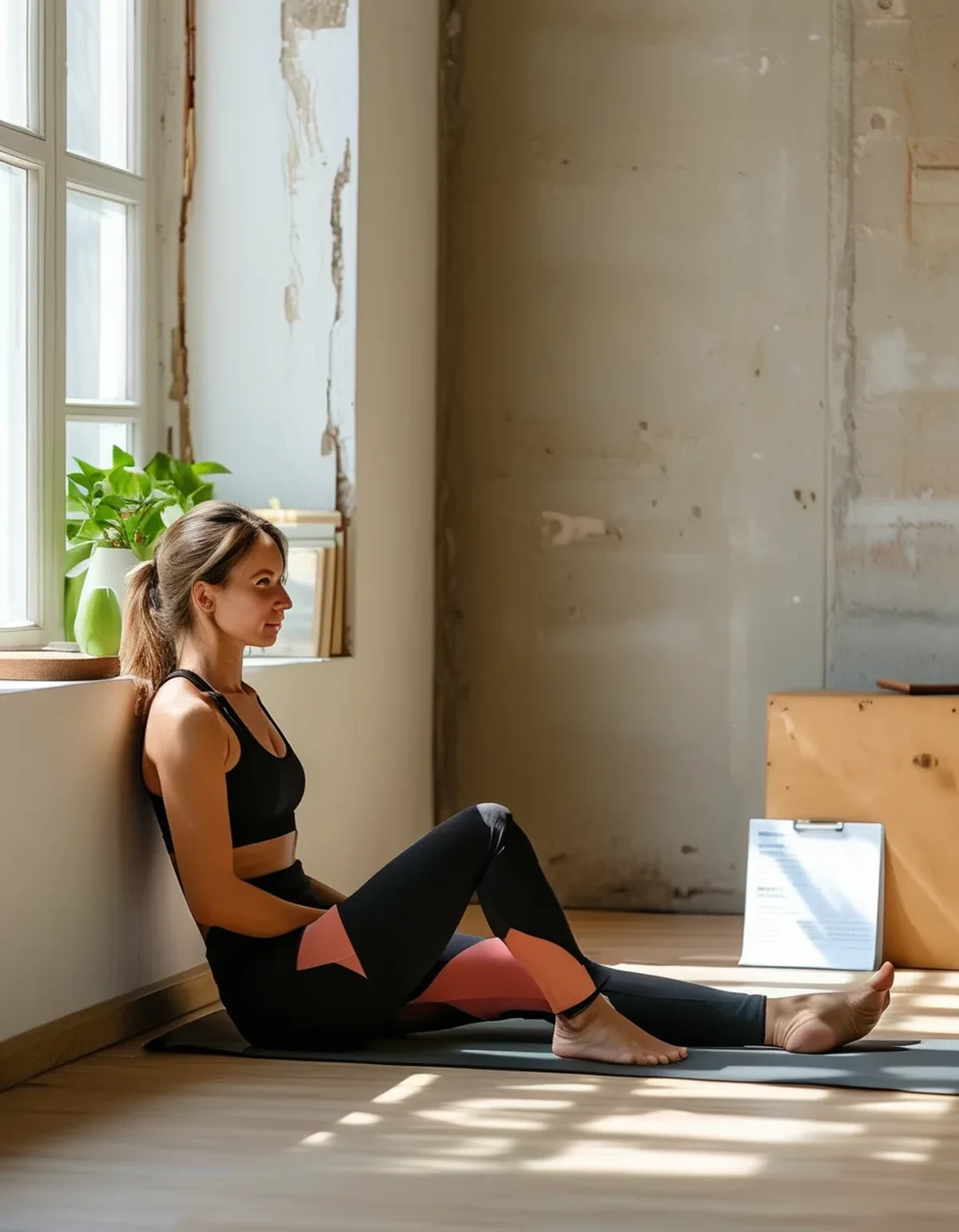
Why use a wall for pilates?
Because it does two jobs at once that normally require an instructor and a reformer.
It’s a form checker. Your spine, shoulders and pelvis against a flat surface give you instant feedback about alignment. You can feel when your lower back arches away or one shoulder sits forward — information you simply don’t get lying on a mat.
It’s a support beam. For balance work and for anyone building back from a break, the wall takes enough load that you can focus on control rather than on not falling over.
The practical result: wall pilates keeps classical movements honest while staying knee-friendly (no deep loaded flexion required) and apartment-silent (nothing jumps, nothing drops). If you’ve abandoned home workouts because of downstairs neighbors, this is the format that solves it.
What does the 28-day plan look like?
Weeks 1 and 2 — Foundation. 10 minutes daily.
- Wall roll-downs — 5 reps. Stand with your back against the wall, feet a foot forward, and peel your spine off the wall one vertebra at a time, then restack.
- Wall-supported bridges — 12 reps. Lie on your back, feet flat on the wall at knee height, lift the hips.
- Feet-on-wall marches — 10 each side. From the bridge position, lift one foot at a time without letting the hips drop.
- Wall calf raises — 15 reps, hands on the wall for balance.
- Wall chest opener — 30 seconds. Forearms on the wall, step back, let the chest open.
Boring on paper, surprisingly spicy in the deep core by day five. That’s the checklist’s job — carrying you through the boring part until the interesting part arrives.
Weeks 3 and 4 — the ladder climbs. 12 minutes daily.
- Wall sits with arm circles — 3 x 30 seconds. The arm circles are what turn a leg exercise into a whole-body one.
- Single-leg bridges on the wall — 8 each side.
- Wall plank variations — 3 x 30 seconds, progressing from hands-high to hands-lower.
- Wall roll-downs with a pause at the bottom — 6 reps.
- Standing wall leg circles — 10 each side.
The move that felt impossible on day 3 becomes the warm-up by day 24. That arc is the entire addiction, and it’s why 28-day formats work when open-ended plans don’t.
How do you actually finish a 28-day challenge?
The psychology matters more than the exercise selection. Four rules that hold up:
Print the grid and cross the days physically. A visible chain of X marks recruits a completely different motivation system than an app notification. Put it somewhere you walk past.
Allow two skip days with makeup rules. Streak flexibility beats streak collapse. A rigid all-or-nothing streak breaks on day 11 and never restarts; a streak with two built-in passes survives real life.
Anchor it to an existing habit. Right after you brush your teeth, right before your shower, immediately after the coffee. Ten minutes floating loose in the day is ten minutes that gets negotiated away.
Photograph day 1 and day 28 from the side. Posture changes are extremely hard to notice in a mirror and extremely obvious in a side-by-side. Same spot, same light, same clothes.
5 Mistakes Everyone Makes in 28-Day Challenges
- Going too hard in week 1. Enthusiasm burns 10 minutes into 40 on day two, and then day five is a rest day, and then day six doesn’t happen. The plan is 10 minutes. Do 10 minutes.
- Treating a missed day as failure. Missing one day has essentially no physical consequence. Quitting because you missed one has all of it.
- No before photo. By day 28 you’ll have completely forgotten what day 1 looked like, which means you’ll under-credit real progress and be less likely to start the next one.
- Wearing whatever’s nearest. A waistband that rolls down during bridges and wall marches is a genuine adherence problem — you stop mid-set to fix it every time. Squat-proof high waist leggings with a wide, flat band remove one of the small frictions that quietly ends challenges.
- Not planning day 29. The most common failure isn’t finishing — it’s finishing and then doing nothing for three weeks. Decide what comes next before day 28 arrives.
Who is wall pilates good for?
Well suited to: beginners, people returning after a break, apartment dwellers, anyone with cranky knees who wants lower-body work without deep loading, and people who need visual alignment feedback.
Worth modifying: if you’re pregnant, skip the flat-on-back positions after the first trimester and stick to standing wall work. If you have a current back, hip or shoulder injury, get the exercise list cleared by a physio first — wall pilates is gentle, but “gentle” and “appropriate for your specific injury” are different questions.
Stop and check in with a professional if any movement causes sharp pain, numbness or tingling down a limb. Muscular burn is expected; nerve symptoms are not.
FAQ
Does wall pilates actually work?
For core endurance, hip strength, posture awareness and mobility — yes, especially for people starting from a low base. It won’t build significant muscle mass on its own, and it’s not a substitute for progressive resistance training if strength is your main goal.
How long until I see results from a 28-day challenge?
Most people notice better posture awareness and core endurance within 10 to 14 days. Visible changes take longer and depend heavily on other factors, which is exactly why the day-1 posture photo is more useful than the scale.
Can I do wall pilates every day?
Yes — 10 to 12 minutes of low-impact work is well within daily recovery capacity for most people. If you’re sore enough that form breaks down, take the skip day. That’s what the two makeup passes are for.
TL;DR:
- 10 minutes daily, one wall, no equipment. Weeks 1–2 foundation, weeks 3–4 the ladder climbs.
- The wall is both a form checker and a support beam — knee-friendly and apartment-quiet.
- Print the grid, cross days physically, and allow two skip days with makeup rules.
- Anchor it to an existing habit. Floating 10 minutes gets negotiated away.
- Take the side-on posture photo on day 1. Then decide what day 29 is before you get there.
Keep Reading
This article is for general informational and styling purposes only. Fit, sizing, and product availability may vary.