The 7-Day Stretching Challenge That Resets Your Body
Quick Answer: A 7-day stretching challenge is 10 minutes of daily stretching for one week, targeting hips, hamstrings, chest, spine and shoulders. Most people notice easier movement and less morning stiffness by day 4–5, because daily frequency matters far more than session length for short-term flexibility gains.
Big fitness challenges fail because they demand too much. You commit to an hour a day, miss day three, and quietly delete the app.
This one asks for ten minutes a day for seven days. That’s it. By Sunday your body genuinely feels different — less stiffness getting out of the car, easier overhead reach, and for a lot of people, better sleep.
Here’s the day-by-day plan.

Why Does Seven Days of Stretching Actually Change Anything?
A week is short enough to commit to and long enough to feel real change.
Daily stretching compounds fast because soft tissue responds to frequency more than duration. Ten minutes every day beats seventy minutes once a week, every time. Your nervous system also adapts — a big chunk of early flexibility gain is simply your body deciding a range of motion is safe.
By day seven, moving feels easier. Not because your muscles physically lengthened much in a week, but because your tolerance and control improved. That’s still real, and it’s still yours.
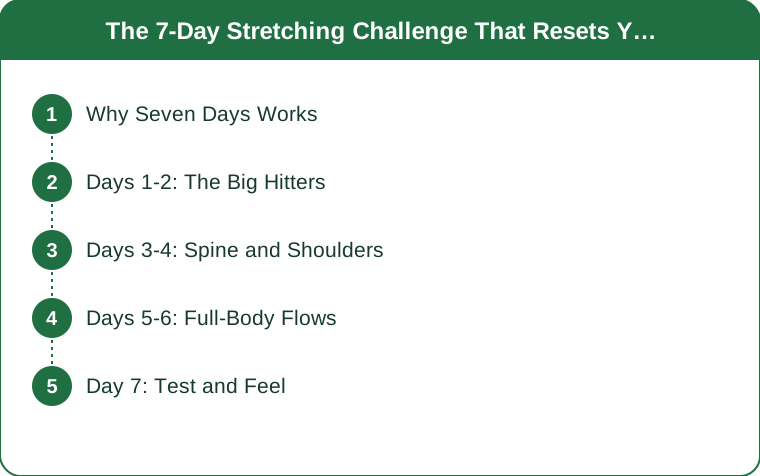
Days 1–2: The Big Hitters
Start with hips, hamstrings and chest — the three areas modern life tightens most, thanks to roughly eight hours a day of sitting with your arms in front of you.
Four stretches, 45 seconds each, both sides where relevant:
- Half-kneeling hip flexor — back knee down, squeeze the glute, gently push hips forward
- Seated or standing hamstring — soft knee, hinge from the hips, don’t round the back
- Doorway chest stretch — forearm on the frame, elbow at shoulder height, step through
- Figure-four glute stretch — on your back, ankle over opposite knee, pull the thigh in
Hold each for 30–45 seconds, breathing slowly. Gentle discomfort yes, sharp pain never. If you’re gripping the couch and holding your breath, back off 20%.

Days 3–4: Spine and Shoulders
Add cat-cow (10 slow reps), a gentle supine twist (45 seconds per side), and shoulder openers — thread-the-needle or a simple wall slide, 8–10 reps.
Your back starts releasing tension you’d stopped noticing. This is the point in the week where people report sleeping better, which makes sense: it’s hard to unclench at bedtime if your thoracic spine has been locked in one shape since 9am.
Keep the big hitters from days 1–2 in the routine. You’re adding, not replacing — the whole thing still fits in ten minutes if you don’t scroll between stretches.
Days 5–6: Full-Body Flows
Link your stretches into one continuous ten-minute flow. Move from figure-four into a twist, from the twist into cat-cow, from cat-cow into a hip flexor lunge.
Moving between positions builds mobility, not just flexibility — and mobility is the one that shows up when you reach into the back seat or pick something off the floor.
This is also where it stops feeling like homework. Around day five most people notice they’re doing it because it feels good, not because a plan told them to.
Day 7: Test and Feel
Repeat day one’s exact stretches. Same positions, same order.
Notice how much further and how much more easily you move. That difference is one week of consistency talking — and it’s the most motivating data you’ll get all month, because you generated it yourself.
If you want a number: on day one, note how far down your shins your fingers reach in the hamstring stretch. Check the same spot on day seven. Two to four inches is a completely normal week’s change.
Myth vs Fact
Myth: You need to stretch for 30+ minutes to get results. Fact: Research on flexibility consistently finds that total weekly volume matters, and short daily doses hit it comfortably. Ten focused minutes daily is roughly 70 minutes a week — plenty.
Myth: Stretching before a workout prevents injury. Fact: Long static holds before lifting or sprinting can slightly reduce power output. Save the long holds for after training or as a standalone session — which is exactly what this challenge is.
Myth: If it doesn’t hurt, it isn’t working. Fact: Pain triggers a protective muscle response, which is the opposite of what you want. The productive zone is a 4–6 out of 10 stretch sensation where you can still breathe normally.
Myth: Flexibility is genetic, so why bother. Fact: Your starting point is partly genetic. Your improvement isn’t. Everyone gains range with consistent work; you’re competing with last Monday, not with the person doing splits on the internet.
What Nobody Tells You About Week One
You’ll probably feel stiffer on day two or three before you feel looser. That’s normal — mild soreness from new positions, not a sign you’ve hurt yourself.
Also: consistency beats perfection so completely that a sloppy six-minute session at 11pm is worth more than a skipped day you promised to “make up tomorrow.” Nobody makes it up tomorrow.
A quick caveat — if you have a recent injury, joint replacement, hypermobility, or pain that radiates down a limb, check with a physio or doctor before starting. Stretching into nerve pain makes things worse, not better.
Mini FAQ
What time of day is best for stretching?
Evening tends to feel easiest — tissues are warmer and more compliant after a day of moving. But the best time is the one you’ll actually repeat, so if 7am is your only reliable window, take it and warm up with two minutes of walking first.
Do I need a mat or any equipment?
No. A carpet or towel is fine. A yoga strap or belt helps with hamstring stretches if you can’t reach comfortably, but a rolled towel does the same job.
What happens after the seven days?
Most people drop to 3–4 sessions a week to maintain, or keep going daily because ten minutes is easy to protect. Gains fade within a few weeks if you stop entirely, so pick a maintenance rhythm before Sunday ends.
TL;DR:
- 10 minutes a day, 7 days: hips/hamstrings/chest → spine/shoulders → flows → retest.
- Hold 30–45 seconds, aim for a 4–6/10 stretch, breathe normally.
- Frequency beats duration — daily short sessions outperform one long weekly one.
- Retest day one’s stretches on day seven for proof you can see.
- Feeling stiffer on day 2–3 is normal; radiating pain is not — see a professional for that.
Seven days, ten minutes each. That’s the whole price of feeling looser, taller and calmer by Sunday. The hardest part is day one; the best part is every day after.
Keep Reading
This article is for general informational and styling purposes only. Fit, sizing, and product availability may vary.