You Missed Three Days of Your Challenge - Here Is What Actually Works Now
Quick Answer: Do not restart from day one, and do not try to make up the missed sessions. Both are the standard responses and both are why three-day gaps become permanent. Instead: resume at the day number you’re on, drop the volume of your first session back by roughly a third, and change the one thing that caused the gap. Streak-based challenges punish you for a gap you can’t undo, so switch your metric from consecutive days to total sessions completed - that number is unaffected by the break and it’s the number that actually reflects the work.
Three days off feels categorically different from one. The physiology doesn’t agree with you, but the psychology is real, and it’s what needs handling first.

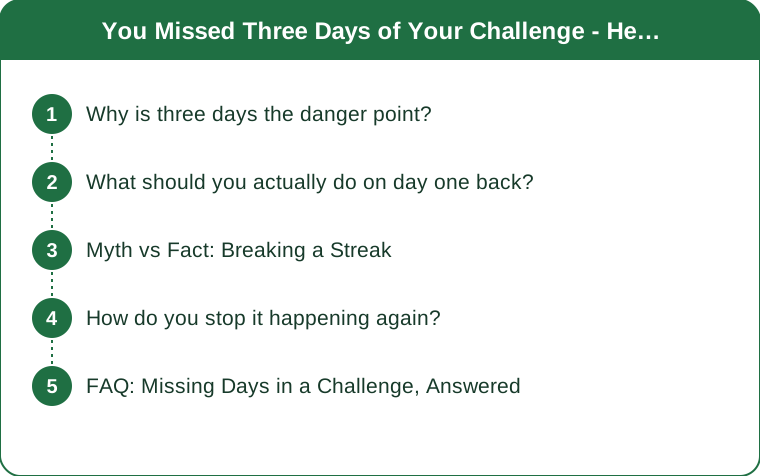
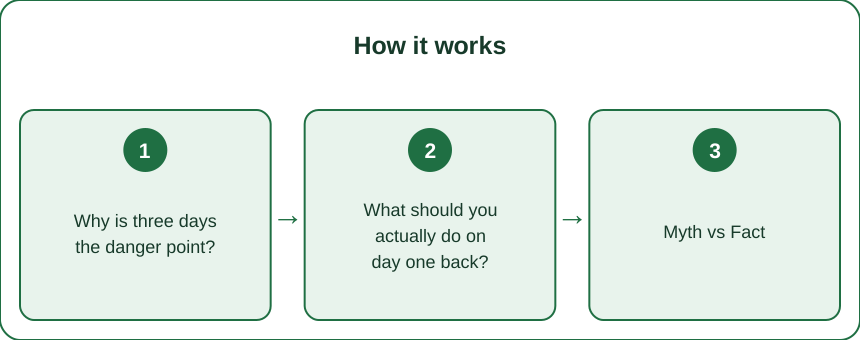
Why is three days the danger point?
One missed day is easily explained; three requires a story. The narrative shifts from I had a busy Tuesday to I’ve fallen off, and once the story changes, the identity follows. That’s the actual mechanism, not motivation.
The streak was doing a lot of the work. If your entire tracking system is consecutive days, a three-day gap deletes the visible evidence of everything you did before it. Losing that display feels like losing the progress, even though the training is banked.
Restarting from day one is a punishment nobody signs up for twice. It converts eleven days of completed work into zero and makes the challenge longer than it was. It’s the most common response and it’s a reliable way to end a challenge.
Making up missed sessions produces a bad session and often an injury. Doubling up after three days off, on a body that hasn’t trained, is where people tweak something - and a tweak ends the challenge properly.
And gaps cluster around predictable causes. Illness, a schedule change, travel, a bad week at work. The gap is usually a symptom of something specific, which means it’s addressable rather than mysterious.
The fitness cost is small. Three days off doesn’t meaningfully reduce strength or fitness. Measurable detraining takes longer than that, and for most people a short break is neutral or mildly beneficial.
What should you actually do on day one back?
Resume at the day number you’re on. If you’re on day fourteen of thirty, do day fourteen. The calendar kept moving; your challenge should too. This single decision preserves everything you built.
Reduce the first session by about a third. Fewer reps, fewer rounds, less time. Not because three days destroyed your fitness, but because an easy re-entry is the one that gets followed by a second session. A punishing return session is the most common cause of a second gap.
Do it today, not on Monday. Waiting for a clean start date adds days to the gap and reinforces the idea that only fresh starts count. The best day to resume is whichever one you’re currently in.
Change the metric to total sessions completed. Eleven of fourteen is a genuinely good number and it’s unaffected by the gap. Consecutive-day counting is the only reason the break looks catastrophic.
Name the cause in one sentence and write it down. Work trip. Sick. Kids’ schedule changed. Naming it converts a vague failure into a specific, recurring, solvable problem.
And define a bad-day version right now. The smallest thing that still counts - five minutes, one set, a walk. Challenges that include a floor survive interruptions; challenges that only have a full version don’t.

Myth vs Fact: Breaking a Streak
Myth: You have to start over. Fact: nothing physiological resets after three days, and starting over is a rule you imposed. Resuming where you are keeps the completed work and shortens the remaining commitment.
Myth: You lost your progress. Fact: measurable strength and fitness loss takes considerably longer than three days. What you lost was momentum and a tidy tracking display, which are recoverable in a single session.
Myth: You should double up to catch up. Fact: this reliably produces a bad session, excessive soreness, and sometimes an injury. There’s nothing to catch up on - the sessions you missed simply didn’t happen, and that’s fine.
Myth: Missing days means you weren’t committed. Fact: gaps are almost always caused by circumstances rather than by willpower - illness, travel, a schedule change, caring responsibilities. Treating a logistics problem as a character flaw is the reason people quit permanently.
Myth: A broken streak means the challenge failed. Fact: a thirty-day challenge completed in thirty-five days with two gaps produced almost exactly the same training as a perfect one. The perfect version exists mainly in other people’s posts.
How do you stop it happening again?
Build the floor into the rules from the start. Every challenge should have a full version and a two-minute version. The two-minute version is what keeps the chain alive on the days everything goes wrong.
Anchor the session to something fixed. Straight after the school run, immediately before your shower, before you sit down in the evening. Anchored sessions survive disruption; sessions scheduled for whenever I get a chance don’t.
Watch the specific weekday that keeps breaking. Most people’s gaps cluster on the same day, and once you see it, you can move that session or pre-plan the short version for it.
Choose a shorter challenge next time. Fourteen days is long enough to build a habit and short enough that life rarely disrupts it. Thirty days spans more schedule variation than most people’s lives can accommodate cleanly.
Track sessions rather than days from the outset. It’s a more honest metric, it’s robust to interruption, and it removes the all-or-nothing framing entirely.
And do it with one other person. Two people restarting after a gap is much more likely than one, because the person who’s still going pulls the other back in. This is general information, not medical advice - if the gap was caused by illness or injury, resume based on how you feel and get advice rather than pushing to a schedule.
FAQ: Missing Days in a Challenge, Answered
Should I restart my 30 day challenge after missing three days?
No. Resume at the day number you’re on, with a session about a third lighter than usual. Restarting converts completed work into zero and makes the whole thing longer, which is why so few people finish the second attempt.
Do I lose fitness after three days off?
Not meaningfully. Measurable detraining takes longer than a few days, and for many people a short break improves the next session rather than harming it.
Should I do extra sessions to make up for missed days?
No. Doubling up on an untrained body produces poor sessions and raises injury risk. The missed sessions simply didn’t happen - there’s nothing to recover.
What’s a better way to track a challenge than a streak?
Total sessions completed. Eleven of fourteen is unaffected by when the gaps fell, it reflects the actual work, and it removes the all-or-nothing framing that makes a three-day break feel terminal.
TL;DR:
- Resume at the day number you’re on - never restart from day one after a short gap.
- Make the first session back about a third lighter, and do it today rather than waiting for Monday.
- Don’t double up to catch up; it produces bad sessions and raises injury risk for no benefit.
- Switch your metric from consecutive days to total sessions completed, which is robust to interruption.
- Name the cause of the gap in one sentence and build a two-minute floor version into the rules.
Three days off costs almost nothing physically. Restarting from day one is what actually costs you the challenge.
Keep Reading
This article is for general informational and styling purposes only. Fit, sizing, and product availability may vary.