Why Two Challenges at Once Means You Finish Neither
Quick Answer: Two simultaneous challenges fail because they compete for the same finite resources - attention, decision-making capacity, and the willingness to be uncomfortable - and because they share a single failure point. Missing a day on either one damages your sense of being on track for both, so the collapse of one usually takes the other with it. Behaviour change research consistently finds that people attempting one change at a time have substantially higher completion rates than those attempting several. Sequence them: run one for its full length, bank it, then start the next.
September arrives, motivation is high, and the plan is obvious - start the 30-day squat challenge and cut out sugar, since you are getting organised anyway.
Day nine, both are gone, and the thing that is hardest to explain is that neither one was individually difficult.

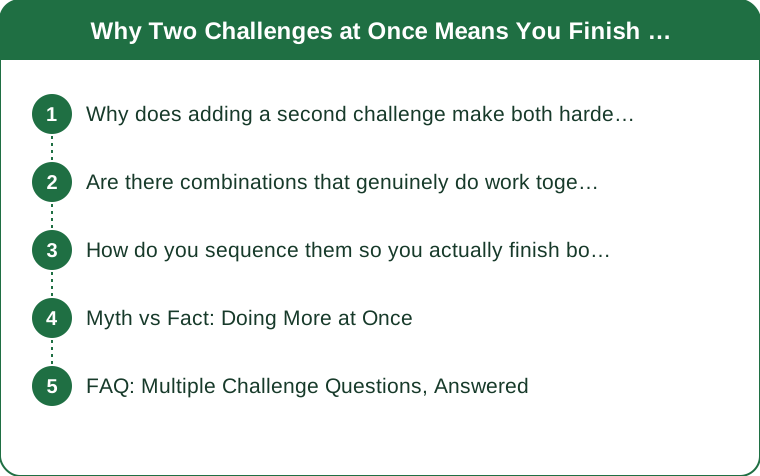
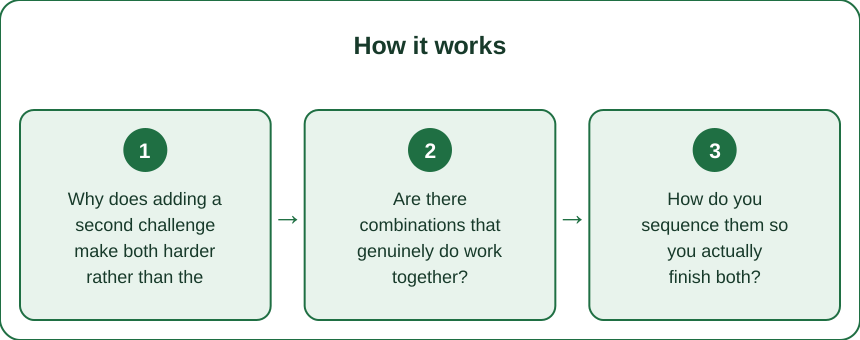
Why does adding a second challenge make both harder rather than the same?
Because they are not independent. They draw on one shared pool and they share a failure point.
The resource is decisions, not willpower. Every challenge converts automatic behaviour into a decision. Two challenges mean two sets of decisions layered onto a day that already had its own. The cost is not additive - it compounds, because you now also have to track and reconcile them against each other. Which comes first when time is short? Does one excuse the other?
They compete for the same slots. Most challenges want early morning or evening, which is precisely when your available time is scarcest. Two challenges targeting the same window will collide within the first week - not occasionally, but structurally.
The failure point is shared. This is the important one. A single bad day breaks both streaks simultaneously. And research on habit formation finds that the psychological damage of a lapse comes largely from the sense of no longer being someone who is on track. Break two at once and that identity blow is doubled, from one event.
And the fatigue is cumulative. Being deliberately uncomfortable is finite in a given week. A tough physical challenge plus a dietary restriction means you are drawing down the same reserve from two directions, and it empties much faster than either alone would suggest.
The research on behaviour change is fairly consistent here: focusing on one change at a time produces markedly better completion than attempting several. The intuition that you should batch them because you are motivated anyway is exactly backwards - motivation is the resource being split.
Are there combinations that genuinely do work together?
Yes, and the distinguishing feature is whether the second thing costs anything.
Combinations that work:
One active challenge plus one passive tracking habit. A squat challenge plus logging your water intake. The second requires noticing, not deciding, which is a much cheaper operation.
One challenge plus one removal. Adding a daily walk while removing the after-dinner phone scroll. Removals in the same time slot can genuinely support each other rather than competing.
Two things that share a trigger and a slot. Stretching immediately after your existing morning coffee, and drinking a glass of water at the same moment. One cue, one location, one moment. This is habit stacking used properly - it works because it does not create a second decision point.
Combinations that reliably fail:
Two things wanting the same time of day. A morning run challenge plus a morning meditation challenge. Whichever loses the collision loses every time.
Two things demanding discomfort. A physical challenge plus a dietary restriction. The most common September pairing and the least likely to survive.
Two things with independent streak counters. Two streaks means twice the chance of a break and twice the demoralisation when it happens.
The useful test before you start a second one: does it require a decision at a moment when I am tired? If yes, it is a second challenge and it will compete. If it happens automatically alongside something already established, it is free and you can carry it.

How do you sequence them so you actually finish both?
Run one at a time, with a deliberate consolidation gap. Four steps.
1. Rank by what has to happen first. If two changes are genuinely connected, order matters - a sleep habit before a 6am training challenge, for instance, since the second depends on the first. Otherwise, start with whichever is cheaper. Early success builds the capacity to attempt the harder one.
2. Run the first for its full length, and shorter is fine. A 21-day version you finish beats a 30-day version you abandon on day eleven. Completion is the thing you are training, more than the specific behaviour.
3. Take a consolidation week before starting the second. This is the step everyone skips. After a challenge ends, spend a week maintaining it at a reduced, sustainable level without adding anything. This is where a challenge becomes a habit rather than a finished project - the most common failure pattern is a completed 30 days followed by an immediate new challenge, with the first behaviour quietly disappearing.
4. Then start the second, keeping the first at maintenance. The first should now cost very little. If it still requires full effort, it is not consolidated and starting the second will cost you both.
Realistic timeline for two changes: roughly ten weeks. Three weeks of challenge one, one week consolidating, three weeks of challenge two, then both at maintenance. That feels slow in September and it produces two changes still in place in December, which the parallel version reliably does not.
And build a floor, not just a goal. Define the minimum version of the current challenge that still counts on a bad day - five squats instead of fifty. A challenge with a floor survives the week that a perfect one does not.
Myth vs Fact: Doing More at Once
Myth: Motivation is highest at the start, so you should take on as much as possible while you have it. Fact: The start is when the systems are weakest. High motivation is exactly what lets you commit to a load you cannot sustain once it fades - which it does, on roughly a two-week schedule.
Myth: Related challenges support each other. Fact: Only if one of them is nearly free. Two things that both require effort compete regardless of how thematically connected they are. Diet and exercise are related in outcome and entirely separate in daily cost.
Myth: If you cannot do two, you were not committed enough. Fact: Completion rates drop with the number of simultaneous changes across the behaviour change literature. This is a design problem, not a character problem.
Myth: Habit stacking means you can add as many as you like. Fact: Habit stacking works when a new behaviour attaches to an existing cue and takes almost no time. It does not scale to two full challenges - the mechanism is a shared trigger, not extra capacity.
Myth: Thirty days makes it a habit, so after a month you are free to add more. Fact: The 21 or 30 day figure has no strong evidential basis. Research on habit formation found a wide range with a median well over two months, and complex behaviours took considerably longer. A finished challenge is a completed project, not an automatic habit.
FAQ: Multiple Challenge Questions, Answered
What if I have already started two and both are wobbling?
Drop one deliberately today rather than letting both decay. Choose the one you care less about, or the one that costs more, and formally park it. A deliberate pause is much easier to come back to than a collapse, and the survivor immediately gets easier.
Can I do a physical challenge and a mental one together?
Sometimes, if the mental one is genuinely low-cost - a two-minute breathing practice rather than a 20-minute meditation. Ask whether it needs a decision when you are tired. If it does, it is a second challenge.
What about a group challenge at work plus a personal one?
The group one usually survives because social accountability is doing part of the work. Treat the personal one as the flexible one, and be honest that you are effectively running one and a half challenges rather than two.
How long should the consolidation week actually be?
At least a week, and two is better for a physical challenge. The signal you are looking for is that the behaviour happens without you scheduling it. Until it does, adding something new will cost you both.
TL;DR:
- Two challenges compete for one pool of attention, decisions, and tolerance for discomfort.
- They share a failure point - one bad day breaks both streaks and doubles the demoralisation.
- A second commitment is free only if it requires no decision when you are tired.
- The reliable pairings are one active challenge plus one passive habit sharing an existing cue.
- Sequence instead: challenge one, consolidation week, challenge two. Roughly ten weeks for two changes.
- Give each challenge a floor, not just a goal, so a bad day does not end it.
The version of you that starts two challenges in the same week is the most motivated you of the entire year, designing a schedule for the least motivated one. Give that person a single thing to do and they will still be doing it in November.
Keep Reading
This article is for general informational and styling purposes only. Fit, sizing, and product availability may vary.