Why Your Challenge Streak Always Breaks on the Same Day
Quick Answer: Missed days cluster. In most people’s challenge logs, 60 to 70 percent of misses fall on one or two specific weekdays - usually the day with the latest work finish, the most childcare handoffs, or a standing evening commitment. The fix is not more discipline. It is redesigning that one day: a shorter version, a different time slot, or a planned rest day placed there deliberately.
If you have failed three challenges and each one died in the same part of the week, you have a scheduling problem wearing a motivation costume.

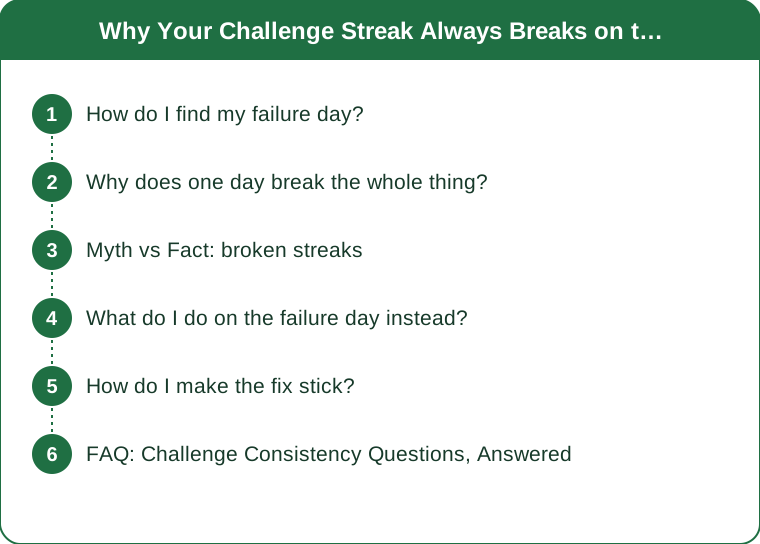
How do I find my failure day?
Look at your last two attempts, not your feelings about them.
Write out the days you missed. Not how many - which ones. Most people find that a challenge that died on day 9 also died on day 16 and day 23, and all three were Wednesdays.
If you do not have the logs, reconstruct from memory in a different way: for each weekday, ask what time you actually got home, whether the evening had a fixed commitment, and how many decisions you had already made that day. The day you miss is usually the day with the most handoffs, not the day with the most hours of work.
The pattern is often invisible because people describe it as randomness. It rarely is. Ten years of habit research consistently finds that lapses cluster around specific recurring contexts rather than distributing evenly.
Why does one day break the whole thing?
Because of what happens the day after.
A single miss costs you almost nothing physically. What it costs is the identity of being someone with a streak, and once that is gone, day 10 has no structural reason to happen. This is sometimes called the what-the-hell effect - after breaking a rule, adherence drops much further than the size of the break justifies.
The data on this is fairly clear. Missing one day has a negligible effect on eventual habit formation. Missing two consecutive days is the strong predictor of dropout.
Which gives you the actual rule to protect: never miss twice. Not never miss. That distinction is the difference between a challenge that survives real life and one that only works during an easy month.
Myth vs Fact: broken streaks
Myth: A broken streak means you have to start over. Fact: Streaks are a motivational tool, not a physiological one. Your body does not reset. Restarting the count is a choice that mostly generates guilt.
Myth: You need more willpower on hard days. Fact: Willpower is worst on exactly the days that are already depleting. Designing an easier version is the higher-percentage move.
Myth: Rest days weaken a challenge. Fact: A planned rest day placed on your known failure day converts a miss into compliance, with zero change in actual behavior.
Myth: If you cannot do the full workout, it does not count. Fact: A 4-minute version on a bad day preserves the habit loop, which is the thing actually being trained in a 30-day challenge.

What do I do on the failure day instead?
Three options, in order of how well they work.
Option 1 - Move the time. If Wednesday evening never happens, do Wednesday morning. Even 15 minutes before the day starts beats 40 minutes that never happens. This is the fix for days where the conflict is a late finish.
Option 2 - Shrink the version. Define a minimum version in advance, in writing: 10 squats, one plank, a 5-minute walk. It has to be small enough that the answer is obviously yes even at 9:30 p.m. Write it down before the day arrives, because you will not negotiate well in the moment.
Option 3 - Schedule it as rest. If the day is genuinely impossible, put your planned rest day there. A 30-day challenge with 4 rest days is a 26-day challenge you finish, which beats a 30-day challenge you quit on day 9.
Most people should do all three across different days of the week rather than picking one.
How do I make the fix stick?
Decide it now, on paper, for a specific day.
The format that works is an if-then plan: If it is Wednesday and I am not home by 7, then I do the 5-minute version in the living room before I sit down. Implementation intentions phrased exactly like that have been shown across dozens of studies to roughly double follow-through compared to general intentions.
Write it somewhere you will actually see on that day, not in a notes app you open weekly. A sticky note on the kettle beats a perfect plan in an app.
Then track the failure day specifically. For four weeks, note only whether that one day happened. You will learn more from four data points on your hardest day than from 28 points across an average week.
And give yourself the never-miss-twice rule out loud. It is the single most useful sentence in this whole subject.
FAQ: Challenge Consistency Questions, Answered
Should I restart the count after a miss?
No. Log it as a miss and continue the day count. Restarting punishes an event that had almost no physical consequence and reliably makes people quit.
What if I miss two days in a row?
Do something tiny on day three, immediately, even if it is 60 seconds. The purpose is breaking the sequence, not the training effect.
Is a 30-day challenge even the right length?
For building a habit, usually not - median habit formation times in research sit closer to 60 days. A 30-day challenge is better used as a structured start than as a finish line.
TL;DR:
- Missed days cluster on one or two specific weekdays, usually the ones with the most handoffs, not the most hours.
- Missing once barely matters. Missing twice in a row is the real dropout predictor.
- Fix the day, not your willpower: move the time, shrink the version, or schedule it as planned rest.
- Write an if-then plan for that specific day, on paper, before the week starts.
- Never restart the count after a single miss.
Go look at your last two attempts and find the day. It is usually the same one, and it has been the actual problem the whole time.
Keep Reading
This article is for general informational and styling purposes only. Fit, sizing, and product availability may vary.