Why a September Challenge Sticks Better Than a January One
Quick Answer: September challenges have better completion rates than January ones for structural reasons: routines are already being rebuilt, the weather supports outdoor consistency, and the social environment reinforces schedules rather than fighting them. January starts push against post-holiday depletion, terrible weather, and a temporary spike of unsustainable ambition. If you want a challenge to finish, start it while your calendar is already reorganising itself.
Everyone starts in January. Most stop by the second week.
The month you choose does real work, and September is the strongest one on the calendar.

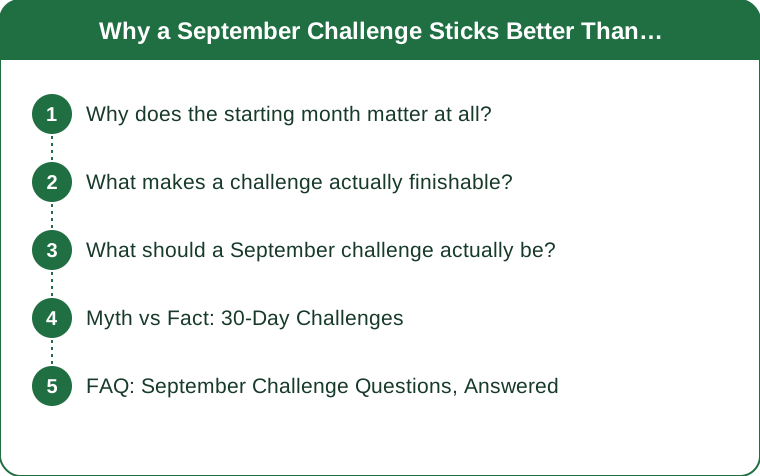
Why does the starting month matter at all?
Because habit formation depends heavily on context, and context varies by season.
New habits attach to existing structure. A behaviour sticks when it’s anchored to stable cues - a fixed time, a consistent route, an unchanging sequence. September is one of only two points in the year when most people’s structure is being rebuilt from scratch, which means there’s a genuine opportunity to build the new thing into the foundation rather than bolting it on.
January’s structure is being restored, not rebuilt. The old routine comes back after the holidays, mostly intact. A new habit in January has to displace an existing one, which is considerably harder than being included in a routine that’s still forming.
Environmental support differs sharply. September gives you comfortable outdoor temperatures, adequate daylight, and open facilities. January gives you darkness at 4:30pm, cold, and a gym at maximum congestion, which is the least pleasant time to be a beginner in one.
Social reinforcement runs opposite to the cliché. January’s mass participation looks supportive and it’s short-lived - most people around you quit within weeks, which normalises quitting. September’s schedule reset is more durable because everyone’s routine genuinely is stabilising rather than spiking.
And the depletion difference is real. January follows a period of disrupted sleep, irregular eating, and elevated spending. September typically follows a lower-stress stretch, which means starting with more capacity available.
What makes a challenge actually finishable?
Four design choices, and most challenges get at least two of them wrong.
1. Make it small enough to be boring. The most common failure is choosing something that feels appropriately ambitious on day one. Ambition on day one is not the constraint - day 18 on four hours’ sleep is. If the daily commitment doesn’t feel almost too easy, it’s too big.
Concrete calibration: if you currently do nothing, 10 minutes daily is the right size. If you train twice a week, adding a daily 10-minute mobility habit is right. Adding daily hour-long sessions is not.
2. Make it binary. “Move for 10 minutes” is checkable. “Exercise more” is not, and unmeasurable commitments erode invisibly. You want a daily yes-or-no.
3. Attach it to a fixed anchor. After coffee, after drop-off, before the shower. Anchored behaviours survive; scheduled-by-clock ones fail on the first disrupted day.
4. Decide the missed-day rule in advance. This is the one nobody plans and everybody needs. Rule: never miss twice. One missed day is statistically irrelevant to habit formation; two consecutive ones are the strongest predictor of abandonment.
Why the standard 30-day framing under-delivers: the popular idea that habits form in 21 or 30 days doesn’t match the evidence well - research on automaticity suggests a wide range, commonly averaging around two months and varying enormously between people and behaviours. So treat 30 days as a starting block, not a finish line.

What should a September challenge actually be?
Five options calibrated to different starting points.
If you currently do nothing: the 10-minute walk. Same time daily, outdoors, non-negotiable. Sounds trivial and it’s the most successful challenge on this list because it never gets skipped for being too hard.
If you train occasionally: daily 10-minute mobility. Five movements, same sequence, same slot. It complements rather than competes with existing training, so it doesn’t create fatigue that undermines your other sessions.
If you want strength: three sets of one exercise daily. Push-ups, squats, or a hinge - rotate across the week, keep the volume low, never go to failure. Daily low-volume work builds skill and consistency far better than three punishing sessions.
If sleep is the actual problem: a fixed wake time for 30 days. The highest-leverage challenge on this list for most people, and the only one that improves everything else simultaneously. Wake time, not bedtime - it’s the one you control.
If you need the outdoor time: 15 minutes outside before 9am. Doubles as light exposure at the point in the year when daylight is dropping fastest, which supports sleep timing and mood.
Pick one. The strongest predictor of failure is running two challenges simultaneously. One binary daily behaviour, 30 days, with a defined missed-day rule - that’s the whole design.
Track it visibly. A paper calendar on the wall with an X per day works as well as anything digital, and better for many people because the streak is physically present rather than in an app you have to open.
Myth vs Fact: 30-Day Challenges
Myth: It takes 21 days to form a habit. Fact: That figure comes from a mid-century surgeon’s observation about patients adjusting to changed appearance, not from habit research. Studies of habit automaticity find wide variation, commonly averaging around two months. Thirty days builds a start, not a finished habit.
Myth: Missing a day ruins the challenge. Fact: A single missed day has essentially no effect on eventual habit formation. Two consecutive missed days is where the risk lies. The all-or-nothing framing is what causes people to abandon after one slip, which is the actual damage.
Myth: Harder challenges produce better results. Fact: Completion rate is what produces results, and difficulty is inversely related to completion. A finished easy challenge beats an abandoned hard one, and it also leaves you with a habit rather than a memory.
Myth: You need to start on the 1st. Fact: Waiting for a clean start date costs you days and adds nothing. The first day of a challenge being a Wednesday has never affected an outcome. Start tomorrow.
Myth: Challenges don’t work because people quit. Fact: Badly designed challenges don’t work. A binary, anchored, appropriately small daily behaviour with a defined missed-day rule has a very different completion profile from an ambitious undefined one - and the design is the variable, not the person.
FAQ: September Challenge Questions, Answered
30 days or something shorter?
Fourteen days is a good option if you’ve abandoned challenges before - a completed 14-day run builds more confidence than an abandoned 30. You can always repeat it, and repeating a completed challenge tends to work better than escalating to a longer one.
What if my schedule is still unstable in September?
That’s an argument for anchoring to events rather than clock times, and for choosing something location-independent. A 10-minute walk or a bodyweight sequence travels; a specific gym class doesn’t.
Should I do it with someone?
It helps if you actually check in with each other regularly, and does nothing if you just both agreed to it. A daily message with a yes or no is the version that works. A shared plan without shared accountability adds no benefit.
What do I do on day 31?
Decide before you get there. The most reliable options are repeating the same challenge or making a small increase - 10 minutes becoming 15. What fails is finishing with no plan, which is why so many completed challenges lead nowhere.
Is it a problem if my challenge feels too easy?
No - that’s the design working. Easy is what gets you to day 30, and day 30 is what builds the underlying habit. You can add difficulty in the next round, once the behaviour is automatic.
TL;DR:
- September beats January because routines are being rebuilt rather than restored, and weather and daylight cooperate
- Design for day 18, not day 1 - if it doesn’t feel almost too easy, it’s too big
- Make it binary, anchor it to an existing event, and track it somewhere visible
- Decide the missed-day rule in advance: never miss twice
- The 21-day habit figure isn’t supported; automaticity commonly takes closer to two months
- Run one challenge, not two, and decide what happens on day 31 before you get there
Don’t wait for January. The best month of the year to start is the one you’re already reorganising.
Keep Reading
This article is for general informational and styling purposes only. Fit, sizing, and product availability may vary.