Why Day One Is the Worst Day to Start a 30-Day Challenge
Quick Answer: Starting a challenge at full intensity on a symbolic date puts the hardest version of the habit into an unprepared schedule, which is why day 8 to 12 is where most challenges collapse. Run three to five days of a scaled-down version first - half the volume, same time slot - so the schedule collision happens before the streak is worth protecting. Then start day one already knowing when and where it fits.
The start date feels like the important decision. The rehearsal you did or did not do beforehand matters more.

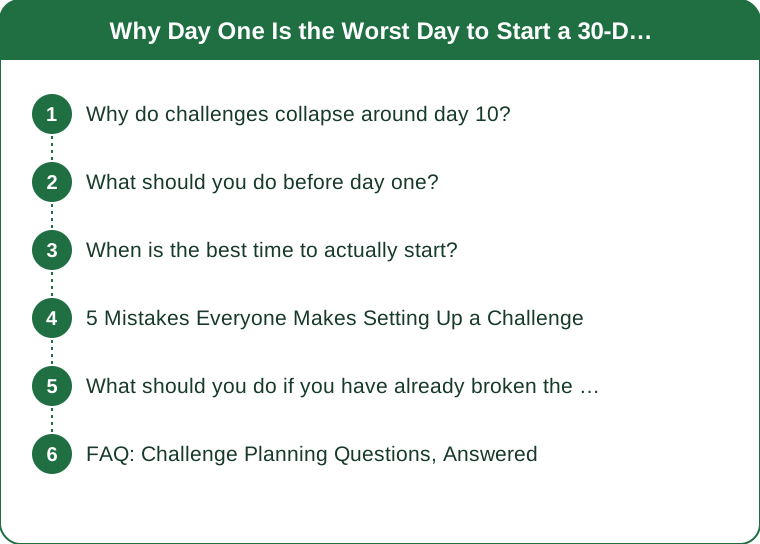
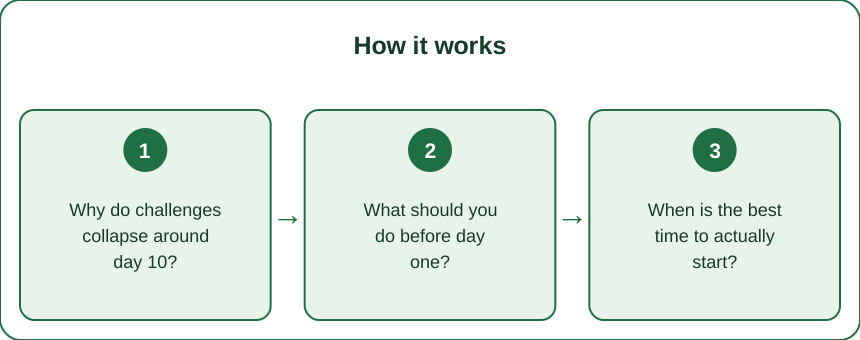
Why do challenges collapse around day 10?
Because the first week runs on novelty, and the second week runs on scheduling.
Week one is genuinely easy for reasons that have nothing to do with discipline. The task is new, the streak is visible, and you have usually cleared some space for it deliberately. None of that is repeatable.
Week two brings the collisions. The evening that runs late, the weekend away, the day you feel unwell, the deadline. These are not unusual events - they are the normal texture of a fortnight, and a challenge designed in the optimism of day one has no plan for any of them.
What actually happens at the collision: you miss one day. The streak breaks. And the streak was doing most of the motivational work, so its loss removes the main reason you were continuing. The all-or-nothing structure that made day one exciting is what makes day 11 terminal.
Three design flaws that make this worse:
- Full intensity from day one, with no ramp. The body is not adapted and the schedule is not tested
- A daily requirement, which means a single missed day is a failure rather than a variance
- A symbolic start date, which forces the start to happen when the calendar says rather than when your actual month is ready
The reframe that helps: the challenge is a scheduling experiment before it is a fitness one. If you know the slot survives a normal week, the rest is comparatively easy.
What should you do before day one?
A rehearsal week. Three to five days, half the volume, at the exact time you intend to use.
What the rehearsal tests:
- Whether the time slot actually exists. Most people discover their planned 7am slot requires a 6:15 alarm they have not been setting
- How long it genuinely takes, including changing, setting up, and putting things away. This is usually 50% longer than the workout itself
- What it collides with. You will find out on day three that Wednesdays do not work, and that is much better news on day three than on day eleven
- Whether the movement is appropriate. If 50 squats produce two days of soreness, 100 daily for a month is not a plan
What the rehearsal is not: it is not the challenge, and the days do not count. That is the point. Nothing is at stake, so a missed day produces information rather than failure.
How to run it:
- Pick the slot and the scaled version - roughly half the target volume
- Do it for three to five days, including at least one weekend day and one day you expect to be busy
- Note what went wrong and when
- Adjust the slot, the volume, or the challenge itself
- Then start day one
The most common adjustment people make after a rehearsal: moving from evening to morning, or halving the daily target. Both of those discoveries save a challenge, and both are essentially impossible to make once a streak is running, because by then changing the plan feels like cheating.
When is the best time to actually start?
In an ordinary week, not a symbolic one, and ideally with the known disruptions already mapped.
Why the first of the month is a poor start date. It is chosen for symbolism, and symbolism does not care whether the month contains a holiday, a work trip, or a house move. A challenge started on the 6th, in a clear fortnight, will beat one started on the 1st into a chaotic one every time.
A better way to choose:
- Look at the next 30 days on your actual calendar. Mark the days you already know will be difficult
- If more than about five are difficult, either shift the start or shorten the challenge. A 14-day challenge in a clear fortnight beats a 30-day challenge with eight impossible days
- Start on a day that is representative, not on a Sunday when everything is easy. Starting on a normal Tuesday tells you more about whether the plan works
Building in the disruptions rather than pretending they will not happen. Decide in advance what happens on the difficult days. A minimum version - five minutes, one set, half the volume - that still counts. The people who finish challenges are almost always the ones who defined a floor, not the ones with the most willpower.
On the 30-day number itself. There is nothing special about 30 days; it is a calendar artefact. Habit formation research suggests the time to automaticity varies enormously between people and behaviours, commonly cited in ranges well beyond a month for anything complex. A 14-day challenge you complete is worth more than a 30-day one you abandon on day 11, and it can be repeated.

5 Mistakes Everyone Makes Setting Up a Challenge
1. Choosing the volume based on day one energy. Whatever feels manageable on the first morning is roughly double what will feel manageable on day 12. Set the target at what you could do on a bad day.
2. Not defining a minimum version. Without a floor, every difficult day is a binary choice between full effort and zero. A defined five-minute version keeps the chain intact and takes almost nothing.
3. Stacking a challenge onto an already-full month. Look at the calendar first. If there are eight difficult days in the next 30, the challenge is not the problem - the timing is.
4. Starting three challenges at once. January-style bundling - workout, diet, sleep, water - fails because each one competes for the same limited attention. One challenge at a time is not a lack of ambition, it is the only version that finishes.
5. Treating a missed day as the end. This is the one that ends the most challenges, and it is entirely a framing problem. Missing one day has essentially no physiological consequence. Missing the fourteen days afterwards, because you decided the challenge was over, has a large one.
What should you do if you have already broken the streak?
Restart the count, not the challenge. The distinction matters and it is not just semantics.
What a missed day actually costs. Physiologically, almost nothing. One missed session in a 30-day block has no meaningful effect on strength, endurance, or mobility adaptation. The entire cost is motivational, and motivational costs are the ones you can choose how to treat.
A more durable structure than a streak:
- Count completions, not consecutive days. Aim for 25 sessions in 30 days rather than 30 out of 30. This builds the missed days in from the start and removes the cliff edge entirely
- Use a weekly target instead of a daily one. Five sessions a week, arranged as you like. Far more robust to a disrupted Tuesday
- Allow two planned rest days, chosen in advance. A challenge with structured rest is a training programme; one without is a test of tolerance
If you are on day 12 and have missed two days: you have done ten sessions in twelve days, which is a good fortnight of training by any normal standard. The only thing that has failed is a counting convention. Continue to day 30 and count the total.
When to genuinely stop and restart differently:
- If the movement is producing pain rather than fatigue
- If the volume has produced soreness that has not resolved in four days
- If you are dreading it rather than finding it hard, which is usually a sign the challenge was badly matched to what you wanted
What to do after any challenge, completed or not: write down what the actual sustainable version would be. Almost everyone finds that number is somewhere between a third and two thirds of the challenge volume. That number is the useful output - the challenge was the experiment that found it.
This is general information rather than medical advice. Pain, rather than muscular fatigue, is a reason to stop and get advice rather than to push through for the sake of a streak.
FAQ: Challenge Planning Questions, Answered
When is the best day to start a 30-day challenge?
An ordinary day in a clear fortnight, after a short rehearsal. The first of the month is chosen for symbolism and pays no attention to what your actual month contains.
How long should the rehearsal be?
Three to five days at roughly half the target volume, in the exact time slot you plan to use. Include one weekend day and one day you expect to be busy.
What if I miss a day?
Continue. Count completions rather than consecutive days - 25 sessions in 30 days is a good outcome and it removes the cliff edge that ends most challenges.
Is 30 days actually the right length?
It is a calendar artefact rather than a physiological one. A 14-day challenge you finish is worth more than a 30-day one you abandon, and it can be repeated.
Can I do more than one challenge at a time?
In practice, no. Each competes for the same limited attention, and bundled challenges fail together rather than separately.
TL;DR:
- Challenges collapse around day 10 because week one runs on novelty and week two runs on scheduling
- Run a three to five day rehearsal at half volume in the real time slot before day one counts
- Check the next 30 days on your actual calendar; five or more difficult days means shift the start or shorten the challenge
- Define a minimum version in advance so a bad day still counts
- Count completions rather than consecutive days - 25 out of 30 is a good outcome, not a failure
The start date is not the decision that matters. Whether you have tested the slot is.
Keep Reading
This article is for general informational and styling purposes only. Fit, sizing, and product availability may vary.