Why a Challenge With a Bad Day Version Beats a Perfect One
Quick Answer: Design two versions of every challenge day before you start: the full version and a two-minute floor version that counts as a completed day. Streaks break on bad days, not on hard days, and a challenge with no legitimate small option forces an all-or-nothing choice at the exact moment you have the least capacity to make a good one.
Day eleven. You got home at nine, you have not eaten, and the plan says forty minutes. So you skip it, and skipping once is not the problem - the problem is that the streak is now broken and the whole thing feels pointless by Thursday.

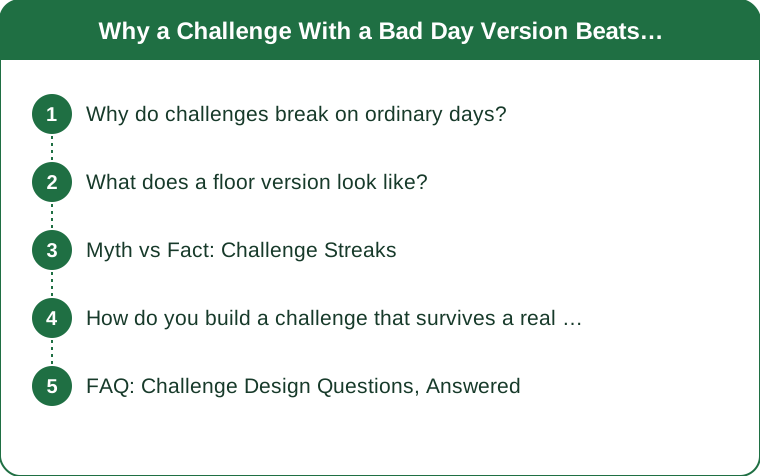
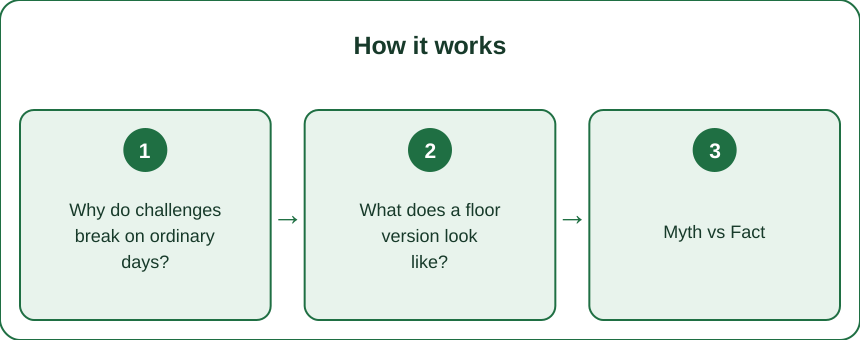
Why do challenges break on ordinary days?
Because the standard challenge design contains a hidden assumption: that every day will resemble the day you were having when you signed up.
You plan a challenge on a good day. You are motivated, you have time, forty minutes sounds reasonable. The plan you write is calibrated to that state. Then real life supplies a week with a late meeting, a bad night’s sleep, a sick child, and a headache, and the plan has no legitimate response to any of them except failure.
All-or-nothing thinking does the rest. Once a day is missed, the streak is broken, and a large proportion of people abandon the whole thing rather than continue with an imperfect record. This is one of the most consistently observed patterns in behaviour change research, and it is why so many challenges die between days 8 and 14 rather than gradually fading.
The second mechanism is decision fatigue. At 9pm on a hard day, you are not choosing between forty minutes and nothing with a clear head. You are making a decision with depleted resources, and the default answer to any effortful question in that state is no.
And there is a third: identity. A missed day is easy to read as evidence about what kind of person you are. That interpretation does far more damage than the missed session itself, which in physical terms is worth almost nothing.
All three problems have the same solution, and it is not more discipline.
What does a floor version look like?
The floor is the smallest version of the day that still legitimately counts. It has to satisfy three conditions.
It must be genuinely achievable on your worst realistic day. Not your worst imaginable day - your worst normal one. Sick, late, tired, out of the house. If there is any version of a normal bad day where the floor is impossible, the floor is too high.
It must take under three minutes. The point is to remove time as a reason. Two minutes is a good target because it is short enough that the objection collapses.
It must be the same shape as the full version. A squat challenge floor is squats, not a walk. The behaviour you are reinforcing is specific.
Examples:
- 30-day squat challenge: full version 60 squats. Floor: 10 squats.
- Walking challenge: full version 8,000 steps. Floor: walk to the end of the road and back.
- Stretching challenge: full version 20 minutes. Floor: two stretches, 60 seconds each.
- Core challenge: full version six exercises. Floor: one 30-second plank.
And the rule that makes it work: the floor counts as a completed day. Not as a partial day, not as a day with an asterisk. If you do the floor, you write it down as done and the streak continues. The moment you treat floor days as failures you have rebuilt the original problem with extra steps.

Myth vs Fact: Challenge Streaks
Myth: Missing one day ruins a challenge. Fact: Physiologically, one missed session in thirty is irrelevant. Psychologically, it is only damaging if you let it end the challenge - and studies on habit formation find that occasional missed days do not meaningfully affect whether a habit forms.
Myth: A floor version is just letting yourself off. Fact: The floor is harder to skip than it is to do, which is the entire mechanism. It keeps the behaviour and the identity intact through the week that would otherwise end the challenge.
Myth: Motivation should carry you through 30 days. Fact: Motivation is highest in the first 72 hours and lowest around days 8 to 14. Any plan that requires steady motivation is designed against the actual curve.
Myth: Harder challenges produce better results. Fact: Completed challenges produce better results. A 60 percent completion rate on an ambitious plan usually delivers less than a 95 percent completion rate on a modest one, and it leaves you considerably less likely to start another.
Myth: You should never restart mid-challenge. Fact: Restarting a challenge you have already attempted tends to go better than starting a brand new one, because you know where your own failure points are. The second attempt at the same challenge is usually the successful one, which is worth knowing before you conclude you are bad at this.
How do you build a challenge that survives a real month?
Five decisions, all made before day one.
1. Write the floor version at the same time as the full version. Both on the same page. If you wait until you need the floor to invent it, you will invent nothing at 9pm.
2. Pick the time of day and defend it. Challenges done at a fixed time survive far better than ones done when convenient, because when convenient means last, and last means never on a busy day. Morning is not magic - consistent is.
3. Decide the two days most likely to break it. Almost everyone has a predictable weak point: a specific weekday with a late finish, or the weekend. Plan the floor version into those days deliberately, in advance, as the intended plan rather than a fallback.
4. Track it somewhere physical and visible. A paper calendar with a mark for each completed day works better for most people than an app, because it is visible without being opened. The floor days get the same mark as the full days.
5. Decide in advance what happens after a genuinely missed day. The rule that works: never miss twice. One missed day is noise. Two consecutive missed days is where challenges actually die. Write that rule down before you need it.
And set the end date properly. Fourteen days is long enough to build something and short enough to see the end from the middle. If 30 days has failed for you three times, that is information about the format, not about you.
FAQ: Challenge Design Questions, Answered
What should I do if I miss a day of a 30-day challenge?
Continue the next day and do not attempt to make it up. The rule that matters is never missing twice in a row - one missed day changes nothing physically, and two is where most challenges end.
Does a shorter workout still count?
Yes, if you decided in advance that it counts. A pre-planned minimum version keeps the habit and the streak intact; an unplanned shortened session tends to feel like failure and does the opposite.
How long should a fitness challenge be?
Fourteen days suits most people better than thirty, particularly if longer challenges have failed before. You can always run a second fourteen.
TL;DR:
- Challenges break on ordinary bad days, not on hard days.
- Write a two-minute floor version at the same time as the full version - and let it count fully.
- Fix the time of day, mark it on paper, and plan floor days into your known weak points.
- Never miss twice; one day is noise, two consecutive days is where it ends.
The people who finish are not the ones with better days. They are the ones who decided in advance what a bad day looks like.
Keep Reading
This article is for general informational and styling purposes only. Fit, sizing, and product availability may vary.