Why a 14-Day Challenge Works Better Than a 30-Day One
Quick Answer: Thirty days is not a magic number - the widely repeated 21 or 30 days to form a habit claim comes from a misreading, and actual habit formation research found a median closer to 66 days with an enormous range. A 14-day challenge works better in practice because it fits inside the window where initial motivation is still high, produces a completed outcome rather than an abandoned one, and can be repeated - and the repetition is what actually builds the habit.
You have started four 30-day challenges. You have finished zero.

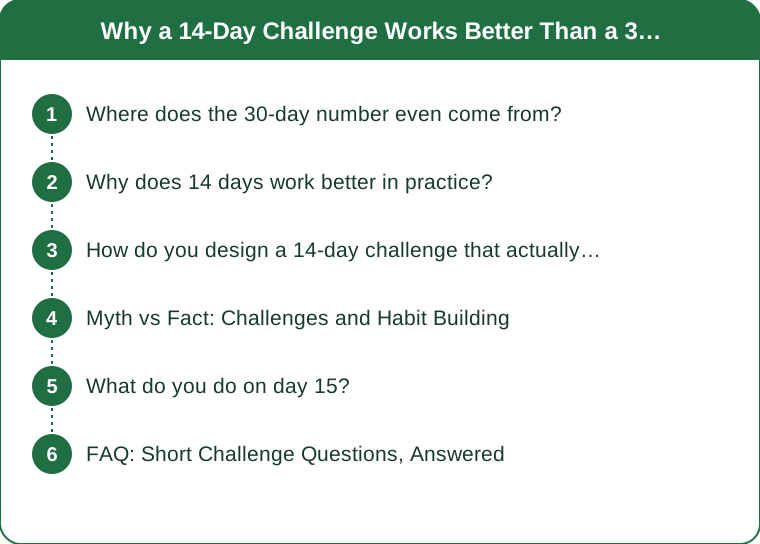
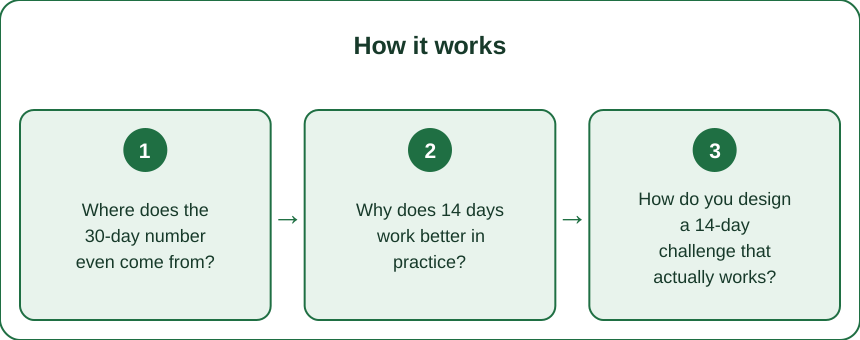
Where does the 30-day number even come from?
It has a traceable and somewhat embarrassing origin, and knowing it makes the whole framework easier to abandon.
The 21-day claim originated with a plastic surgeon’s observations in the 1960s about how long patients took to adjust to a changed appearance, published in a self-help book. It was an observation about psychological adjustment, not habit formation, and it was never a controlled finding. It then propagated through decades of self-help material until it became received wisdom.
Thirty days is essentially a rounding of that, chosen because it maps neatly onto a calendar month. It is a marketing-friendly unit, not a physiological one.
The actual research is more interesting and less tidy. A well-known study on habit formation found that automaticity took a median of around 66 days to develop, with a range spanning roughly 18 to over 250 days depending on the behaviour and the person. Simple behaviours formed faster than complex ones.
Which means both numbers are wrong in opposite directions. Thirty days is too short for genuine habit automation and too long for the motivational window most people can sustain unaided. It is the worst of both - long enough to fail, short enough not to have built anything.
The honest conclusion: stop treating the challenge as the habit-building mechanism. The challenge is a starting device, and it should be sized for what a starting device can do.
Why does 14 days work better in practice?
Four reasons, and the first one is the important one.
1. It fits inside the motivation window. Initial motivation after starting something is high and decays. For most people it holds reasonably well for one to two weeks and drops noticeably after that - which is why abandonment clusters around days 10 to 14 in 30-day challenges. A 14-day challenge ends at exactly the point where a 30-day one starts failing.
2. You finish. This is not a trivial difference. Completing something builds self-efficacy - the belief that you do what you say you will do - and that belief is the resource every subsequent attempt draws on. Repeatedly abandoning challenges depletes it, which is why the fifth attempt is harder than the first rather than easier.
3. Two weeks is forecastable. You can look at the next fourteen days and know roughly what is in them. Thirty days reliably contains something you did not plan for - a trip, an illness, a work crisis - and that unplanned event is usually what ends it.
4. It is repeatable without ceremony. Finishing on day 14 and starting again on day 15 produces 28 days of behaviour with an intact completion record. The same 28 days as a single block would have had a failure in the middle.
The mechanism is that repetition, not duration, is what builds the habit - and repetition is much easier to sustain when each unit ends in a success.
How do you design a 14-day challenge that actually works?
Six rules. They are boring and they are the whole difference.
1. Make it absurdly small. Smaller than you think is worth doing. Ten minutes, not forty. Two sessions a week, not six. The purpose of the first cycle is completion, not training effect - and people consistently set a target calibrated to their motivation on day one, which is the highest it will ever be.
2. One behaviour only. Not exercise plus water plus sleep plus no sugar. Multi-behaviour challenges fail at the rate of the weakest component, which means stacking four halves your odds four times over.
3. Define the minimum version explicitly, in advance. What counts on the worst possible day. Five minutes? One set? A walk around the block? Deciding this while motivated protects you on the day you are not, and it is the single most effective design feature in any challenge.
4. Build in the miss rule. Not if you miss a day, but when. The standard rule that works: never miss twice. One missed day is noise; two consecutive is where abandonment starts.
5. Make it visible. A paper calendar on a wall with a mark for each day. Physical, visible streaks outperform app-based tracking for most people because they are unavoidable rather than opened voluntarily.
6. Decide the day-15 plan on day 12. The end of a challenge is where progress evaporates, because the structure disappears with nothing replacing it. Decide before you finish whether you are repeating, extending, or changing it.

Myth vs Fact: Challenges and Habit Building
Myth: It takes 21 days to form a habit. Fact: The figure came from a 1960s observation about adjustment to appearance, not from habit research. Actual estimates centre around a median of roughly 66 days with a very wide range.
Myth: If you miss a day you have to start over. Fact: There is no evidence for a reset requirement, and the belief is actively harmful - it converts a single missed day into a reason to abandon the whole attempt. A missed day has a negligible effect on habit formation. Deciding it invalidates everything does not.
Myth: Longer challenges produce better results. Fact: Only if you complete them. A completed 14-day challenge produces more behaviour and more self-efficacy than an abandoned 30-day one, which is the comparison that actually applies.
Myth: You need to feel motivated to keep going. Fact: Motivation is unreliable by construction. Structure, small targets, and visible tracking carry the behaviour through the periods when motivation is absent, which is most of them.
Myth: The challenge is the point. Fact: The challenge is a starting device. The point is what you are still doing in March, and challenges only serve that if they end in a transition rather than a stop.
Myth: Doing it every day is better than three times a week. Fact: For habit formation, consistency of the cue matters more than daily frequency. A behaviour attached to a reliable weekly slot can form perfectly well, and daily targets for something that genuinely takes an hour tend to collapse.
What do you do on day 15?
This is the question that determines whether the challenge was worth doing, and almost nobody plans for it.
Option 1 - Repeat identically. The best default. Same behaviour, same size, another 14 days. You now have 28 days of behaviour and two completions, and the second cycle is easier than the first.
Option 2 - Repeat slightly larger. Ten minutes becomes fifteen. Increase one variable only, by a small amount. Increasing everything at once turns cycle two into a new challenge with a fresh failure risk.
Option 3 - Add a second behaviour, only after two clean cycles. Not before. Adding behaviours is how challenges become the multi-component versions that fail.
Option 4 - Convert it to a schedule. Move it from a challenge with an end date to a permanent slot in the week. This is the actual goal, and it works best after two or three successful cycles, when the behaviour no longer needs the challenge framing to happen.
What not to do: finish on day 14 and take a break to celebrate. The break is where it dies. If you want a break, take one day and have day 15 already scheduled.
And be realistic about the timeline. Something like four to five 14-day cycles gets you into the range where habit research suggests automaticity starts to appear for simpler behaviours. That is a couple of months, which is a considerably more honest answer than thirty days.
FAQ: Short Challenge Questions, Answered
Is 14 days long enough to see any physical change?
Generally not visible change, no - and that is the wrong success criterion. Fourteen days is long enough to establish that you can do the thing consistently, which is what the cycle is for.
What if I miss two days in a row?
Restart the count, not the challenge. Keep the same behaviour and the same target, and note what caused the miss, since it will almost certainly happen again.
Should the challenge be daily or a few times a week?
Daily works well for small behaviours - ten minutes, a walk, a stretch. For anything longer than about twenty minutes, three fixed days a week is more realistic and forms habits just as well.
Do public challenges with other people work better?
Social accountability helps most people, and it works best with one or two specific people rather than a large group where nobody notices your absence.
Why do I keep abandoning challenges around week two?
Because that is where initial motivation decays and, in a 30-day format, there is still half of it left. Ending at that point rather than pushing through it is exactly why the shorter cycle works.
TL;DR:
- The 21 and 30-day figures come from a misread 1960s observation, not habit research
- Real habit formation estimates centre near 66 days with a huge range - 30 was never meaningful
- 14 days ends where motivation decays, so you finish instead of abandoning
- Make it absurdly small, one behaviour only, define the minimum version in advance, never miss twice
- Decide your day-15 plan on day 12 - the end of a challenge is where progress dies
Four completed cycles beats four abandoned months. That is the entire argument.
Keep Reading
This article is for general informational and styling purposes only. Fit, sizing, and product availability may vary.