The Hidden Reason 30-Day Challenges Work Better When You Do Them With Someone
Quick Answer: Doing a 30-day challenge with a partner improves completion rates not primarily through motivation, but through a specific mechanism called social commitment - a scheduled check-in with another person creates a harder-to-skip deadline than a private, self-imposed one. Pairs also catch and correct each other’s early quitting signals faster than solo trackers.
“Find an accountability partner” gets repeated so often in challenge advice that it’s become background noise. Here’s the actual mechanism behind why it works, and what makes some partnerships far more effective than others.

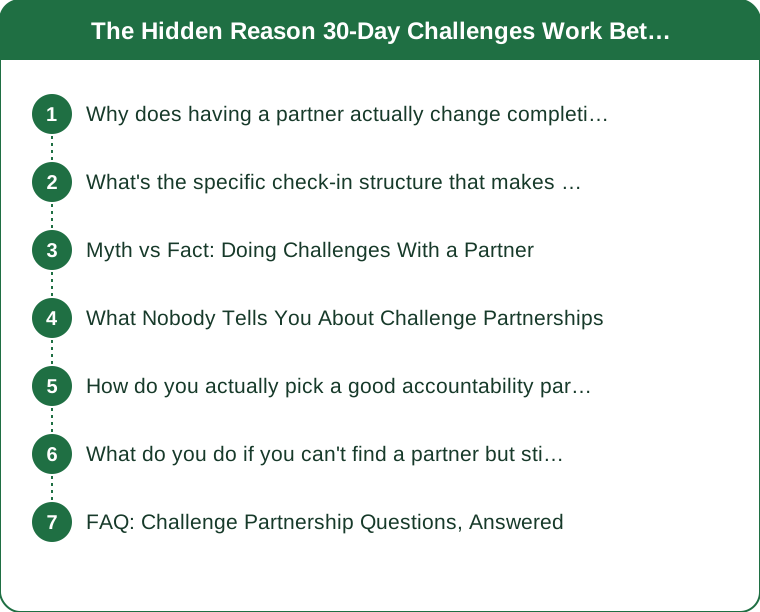
Why does having a partner actually change completion rates, not just motivation?
The core mechanism is social commitment, not motivation or encouragement. A private goal is easy to quietly renegotiate with yourself at 9pm on a tired day - a scheduled check-in with another person creates an external deadline that’s psychologically harder to skip than an internal one, even when your actual motivation level is identical in both scenarios.
This is a well-documented pattern in behavior change research broadly, not specific to fitness or 30-day challenges - external accountability structures consistently outperform purely internal ones for habit completion, largely because they add a social cost to quitting that a solo attempt simply doesn’t have.
What’s the specific check-in structure that makes partnerships actually work?
A brief, scheduled daily or every-other-day check-in - even just a one-line text confirming completion - outperforms a vague “let’s do this together” arrangement with no defined communication pattern. The structure matters more than the depth of conversation; a simple “done” message exchanged consistently tends to sustain a partnership better than occasional long check-ins with gaps in between.
Setting this structure explicitly before day 1 - not organically figuring it out mid-challenge - removes ambiguity about who’s supposed to reach out and when, which is one of the more common reasons accountability partnerships quietly dissolve around week 2.
Myth vs Fact: Doing Challenges With a Partner
Myth: Your partner needs to be doing the exact same challenge as you for it to work. Fact: The accountability mechanism works even with different challenges or goals, as long as the check-in structure itself is consistent - what matters is the mutual commitment to reporting in, not identical activities.
Myth: A partner mainly helps by cheering you on and providing encouragement. Fact: The bigger effect is structural - a scheduled check-in creates a real deadline and social cost to skipping, which changes behavior more reliably than encouragement alone, even though encouragement feels like the more obvious benefit.
Myth: If your partner drops out, your own challenge is doomed too. Fact: A partner dropping out removes a support structure, but it doesn’t have to end your challenge - many people successfully switch to solo tracking or find a new partner mid-challenge rather than quitting entirely.

What Nobody Tells You About Challenge Partnerships
Here’s the part accountability advice usually skips: partners are most valuable specifically around days 7-12, the window where the largest share of 30-day challenge dropouts happen, not evenly throughout the full 30 days. Early enthusiasm (days 1-5) rarely needs much external support, and by days 20+, the habit has often become somewhat self-sustaining - the middle window is where a check-in partner earns its actual keep.
The other overlooked detail: a mismatch in partner intensity or consistency can actually hurt more than having no partner at all. If one person is highly consistent and the other frequently misses check-ins, the consistent partner often reports feeling more discouraged than if they’d never set up a partnership in the first place - inconsistent accountability can undermine confidence in a way that no accountability doesn’t.
The genuinely surprising finding from behavior-change research: accountability to someone you don’t know especially well (a challenge group member, an online partner) sometimes works better than accountability to a close friend, since there’s less social permission to make excuses or renegotiate the terms with someone who doesn’t already know your full context and reasons.
How do you actually pick a good accountability partner for a 30-day challenge?
Prioritize someone with a similarly serious commitment level over someone you simply like spending time with - a partner who treats the challenge casually will often unintentionally give you permission to treat it casually too, through modeling rather than any explicit conversation.
Choose someone in a different enough time zone or schedule that check-ins happen independently, rather than only when you happen to see each other in person - this ensures the accountability structure survives days when your paths don’t naturally cross, which matters more over a full 30 days than it might seem on day 1.
A short conversation before starting about what happens if one person misses a day - is it a simple restart, a brief note of what went wrong, no big deal - removes ambiguity that can otherwise turn one missed check-in into an awkward silence that quietly ends the whole partnership.
What do you do if you can’t find a partner but still want the accountability effect?
A public commitment - posting your challenge goal somewhere visible, even to a small audience - can partially replicate the social commitment mechanism, though research suggests it’s generally somewhat less effective than a direct one-on-one check-in relationship specifically because there’s no expectation of a personal response back.
Some apps and online communities built around habit tracking or 30-day challenges specifically provide a structured check-in system with relative strangers, which, as covered above, can work surprisingly well precisely because of the lower social stakes involved compared to accountability with someone who knows your full situation.
FAQ: Challenge Partnership Questions, Answered
Is a workout partner the same thing as an accountability partner?
Not necessarily - a workout partner who trains with you in person provides a different (also valuable) benefit than a check-in accountability partner, who can be remote and simply confirm daily completion without doing the activity together.
What’s the minimum check-in frequency that still provides a real accountability benefit?
Even a simple daily one-line text exchange provides meaningful benefit - the specific frequency matters less than consistency, so a realistic schedule you’ll actually maintain beats an ambitious one you’ll likely abandon by week two.
Should we set a specific consequence for missing check-ins, or keep it low-pressure?
Both approaches work for different people - some benefit from a mild agreed-upon consequence (a small favor owed, a light-hearted penalty), while others do better with a purely supportive, no-consequence structure. Choose based on what actually motivates you rather than assuming one approach is universally better.
TL;DR:
- Partner accountability works mainly through social commitment structure, not motivation or cheerleading
- Days 7-12 are when a partner’s value is highest, since that’s the most common dropout window
- A mismatched-intensity partnership can hurt more than having no partner at all
- Set the check-in structure and miss-a-day plan explicitly before day 1, not organically mid-challenge
The partner doesn’t need to be doing the same challenge or even someone you know well - what actually matters is a consistent, low-friction check-in structure agreed on before you start.
Keep Reading
This article is for general informational and styling purposes only. Fit, sizing, and product availability may vary.