Why Accountability Partners Fail Most 30-Day Challenges
Quick Answer: Most accountability partnerships fail because they only define what to do, not what happens when one person misses a day — without a pre-agreed response to a missed check-in, both people tend to let the first slip go unaddressed, and that’s usually where the whole partnership quietly unravels.
Accountability partners get set up around a shared goal, which feels like enough at the start, but the partnership’s real test isn’t day one — it’s the first missed day, and most pairs never actually plan for that moment in advance.

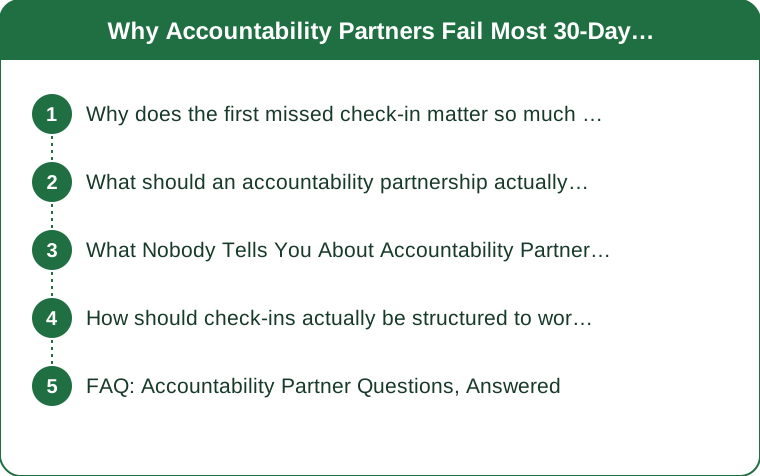
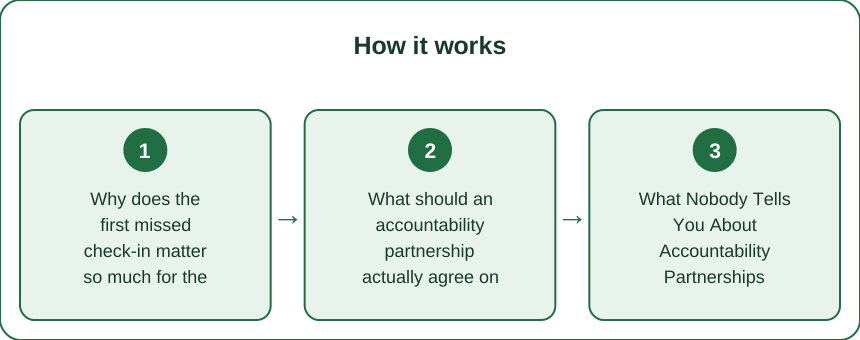
Why does the first missed check-in matter so much for the whole challenge?
Without a pre-agreed plan, the natural response to a partner’s missed day is polite silence — nobody wants to be the one to call it out, so the miss goes unaddressed, which quietly signals that missed days are acceptable. That precedent, set once, tends to compound quickly for both people, not just the one who missed.
What should an accountability partnership actually agree on upfront?
A specific, concrete response to a missed day — a check-in text by a set time, a small agreed consequence, or simply a required same-day explanation — removes the ambiguity that leads to silent letting-it-slide. Agreeing on this before the challenge starts, not improvising in the moment, is what actually makes the difference.

What Nobody Tells You About Accountability Partnerships
A partner who’s also trying to hit a personal goal isn’t automatically a better accountability partner than someone who isn’t. Two people both trying to stay consistent can end up quietly giving each other permission to slack, since holding a partner accountable while also managing your own compliance creates a conflict of interest that a purely supportive, non-participating accountability partner doesn’t have.
How should check-ins actually be structured to work long-term?
A short, specific check-in (a single message confirming completion, not a long discussion) at a consistent daily time is more sustainable than an open-ended “check in when you can” arrangement, which tends to drift and eventually stop happening altogether.
FAQ: Accountability Partner Questions, Answered
Is a group accountability setup better than a one-on-one partner?
Groups can work well since a miss is less likely to go completely unnoticed, though they also dilute individual responsibility somewhat compared to a one-on-one arrangement.
What if my accountability partner and I both miss the same day?
Having the agreed missed-day response apply regardless of whether it happens simultaneously keeps the structure consistent and prevents mutual let-it-slide moments.
Should accountability partners set the same goal or can they be different?
Different goals work fine — what actually matters is the check-in structure and missed-day agreement, not whether the specific goals match.
TL;DR:
- Most accountability partnerships fail at the first missed day, not from lack of initial commitment
- Agree on a specific response to a missed check-in before the challenge starts
- A partner also chasing their own goal can create a mutual let-it-slide dynamic
- Short, consistent daily check-ins hold up better than open-ended “check in when you can”
Keep Reading
This article is for general informational and styling purposes only. Fit, sizing, and product availability may vary.