Why Most People Quit 30-Day Fitness Challenges Around Day 10 (and How to Not Be One of Them)
Quick Answer: Day 8-12 is when initial motivation naturally fades and the routine hasn’t yet become automatic, creating a specific vulnerable window — building in a pre-planned ‘lighter’ version of the challenge for exactly this stretch, rather than expecting the same intensity throughout, is what gets most people through it.
The first week runs on enthusiasm. By day 10, that enthusiasm has faded and habit hasn’t fully formed yet — it’s a well-documented gap, not a personal willpower failure specific to you.

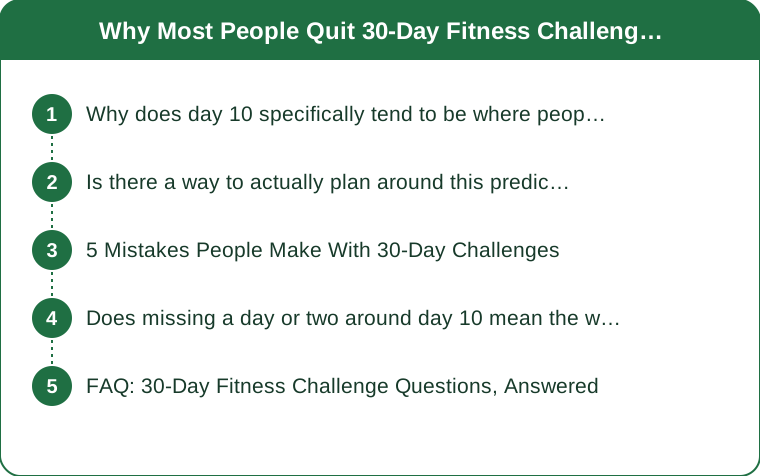
Why does day 10 specifically tend to be where people quit?
Initial motivation from novelty typically fades within 7-10 days, while habit formation research suggests routines generally need closer to 3-4 weeks of repetition to start feeling automatic — day 10 sits squarely in the gap between those two, where the initial excitement is gone but the routine hasn’t become easy yet.
This isn’t unique to fitness challenges specifically — the same drop-off pattern shows up across many habit-formation contexts, which is why anticipating it rather than being surprised by it is the more useful approach.
Is there a way to actually plan around this predictable drop-off point?
Pre-planning a deliberately lighter version of the challenge for days 8-14 (shorter workouts, easier variations) rather than expecting to sustain day-1 intensity throughout removes the all-or-nothing trap that causes many people to quit entirely rather than just scale back temporarily.
Some successful 30-day challenge formats explicitly build in a lighter ‘recovery week’ around this point for exactly this reason, rather than presenting uniform difficulty across all 30 days.

5 Mistakes People Make With 30-Day Challenges
Mistake 1: Expecting day-1 motivation levels to remain constant throughout. Motivation naturally fluctuates; expecting otherwise sets up a false sense of failure when it dips.
Mistake 2: Treating one missed day as reason to quit entirely. Missing a single day and restarting the next is very different from actually failing the challenge.
Mistake 3: Not having a lighter backup version planned for the low-motivation window. All-or-nothing structure makes quitting more likely than scaling back would.
Mistake 4: Choosing a challenge that’s too intense from day 1, front-loading burnout risk before habit has any chance to form.
Mistake 5: Not tracking progress visually. A visible streak or calendar significantly increases follow-through compared to just mentally tracking it.
Does missing a day or two around day 10 mean the whole challenge is ruined?
No — missing 1-2 days and resuming is a completely different outcome than fully quitting, and most successful challenge completions include at least one missed or modified day somewhere in the 30-day span.
The all-or-nothing mindset (believing a missed day invalidates the whole effort) is itself one of the more common reasons people quit entirely rather than simply continuing after a gap.
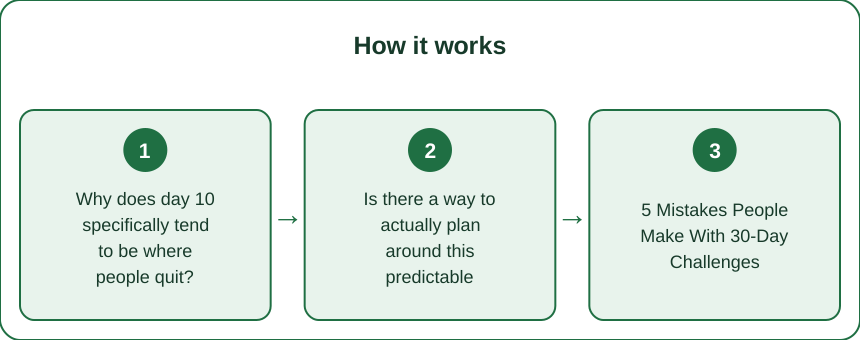
FAQ: 30-Day Fitness Challenge Questions, Answered
Is it better to pick an easier or harder challenge for a first attempt?
An easier, more sustainable challenge that you’re likely to complete builds more long-term momentum than an intense one that leads to quitting by day 10.
Does a visible tracking method (calendar, app streak) really make a measurable difference?
Yes — visible progress tracking is consistently associated with higher completion rates across habit-formation research.
Should the challenge intensity increase, decrease, or stay flat across the 30 days?
A slight decrease or plateau around days 8-14 (the predictable low-motivation window), followed by a gradual increase in the final week, tends to support better completion rates than flat or increasing difficulty throughout.
TL;DR:
- Day 8-12 is a predictable motivation dip, not a personal willpower failure
- Pre-planning a lighter version for this window prevents the all-or-nothing quit trap
- Missing 1-2 days and resuming is very different from actually quitting
- Visible tracking and a slightly reduced difficulty window improve completion rates
The drop-off point is predictable enough to plan around — expecting it changes whether you push through or quit right when it hits.
Keep Reading
This article is for general informational and styling purposes only. Fit, sizing, and product availability may vary.