What to Do When Life Interrupts Your 30-Day Challenge in Week One
Quick Answer: Missing days in week one of a 30-day challenge doesn’t mean starting over from day zero or abandoning it — the most effective response is picking up exactly where you left off rather than restarting the count, since the habit-building value comes from total consistent days, not an unbroken streak from day one.
A sick kid, a work emergency, a bad week — and suddenly your 30-day challenge has three missed days before it really got going. That feels like a sign to quit, but it’s actually one of the most common and recoverable moments in the entire process.

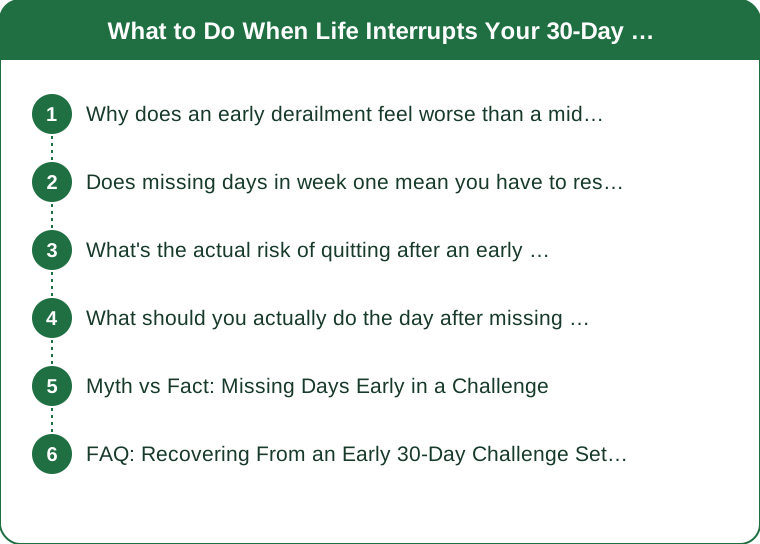
Why does an early derailment feel worse than a mid-challenge one?
Early setbacks hit harder psychologically because you haven’t yet built any sense of momentum or proof that you can do this, so a missed day in week one can feel like confirmation of doubt rather than just a normal bump. A missed day in week three, by contrast, usually feels like a blip because you already have two weeks of evidence that you’re capable of the habit.
Does missing days in week one mean you have to restart the count?
No — restarting the count to ‘day one’ every time you miss a day is one of the most common reasons people abandon 30-day challenges entirely, since it turns an unbroken streak into the actual goal rather than the underlying habit. Picking up from where you left off, counting total completed days rather than consecutive days, preserves the progress you’ve already made and removes the all-or-nothing pressure that causes people to quit.
What’s the actual risk of quitting after an early derailment?
Quitting after a week-one setback reinforces a pattern where any imperfection becomes a reason to stop entirely, which then applies to future goals as well, not just this specific challenge. Continuing despite missed days, even imperfectly, builds a different and more useful pattern — that setbacks don’t have to end the effort.

What should you actually do the day after missing several days?
Simply resume the challenge the next day, without any dramatic restart ritual or renewed ‘day one’ framing — treat the missed days as a gap in an otherwise ongoing effort, not as evidence the whole thing failed. If the schedule allows, you can extend the challenge by the number of missed days to still reach the full 30 completed days, though this is optional, not required.
Myth vs Fact: Missing Days Early in a Challenge
Myth: A broken streak means the challenge has failed. Fact: Total consistent effort over time builds the habit, not an unbroken streak — most successful habit changes include some missed days along the way.
Myth: Restarting from day one after a miss shows discipline. Fact: Restarting the count repeatedly is one of the most common reasons people give up entirely, since it keeps resetting the emotional payoff of progress.
FAQ: Recovering From an Early 30-Day Challenge Setback, Answered
Should I extend the challenge to make up for missed days?
It’s optional — extending by the missed number of days is fine if it helps you feel like you completed the full commitment, but it’s not required for the habit-building benefit.
What if I miss days again later in the challenge?
The same approach applies — resume from where you left off rather than restarting, regardless of how many times a setback happens.
Is it normal to miss days in the first week specifically?
Yes, very common — the first week often coincides with adjusting a new routine around existing commitments, which makes early disruption more likely, not less.
TL;DR:
- Early setbacks feel worse because you haven’t yet built proof you can do this
- Restarting the day count after a miss is a common reason challenges get abandoned
- Resume from where you left off, counting total days completed, not consecutive streaks
- Missing days in week one is common and doesn’t predict whether you’ll finish
If you missed a few days this week, just resume tomorrow — the challenge isn’t broken, and neither is your progress.
Keep Reading
This article is for general informational and styling purposes only. Fit, sizing, and product availability may vary.