21 Days or 30: Which Challenge Length Actually Fits Your Goal
Quick Answer: 21 days suits habit-formation and skill goals — the target is showing up, not adaptation. 30 days suits strength and endurance goals, where you need enough sessions to see measurable change. Choosing the wrong length is why challenges are abandoned around day 10, and the mismatch is more common than a motivation problem.
Everything is 30 days. It has been 30 days since the first magazine challenge, and nobody has revisited the number since.
But a mobility challenge and a push-up challenge are chasing completely different adaptations on completely different timelines, and forcing both into the same box is why one of them always feels like a slog.

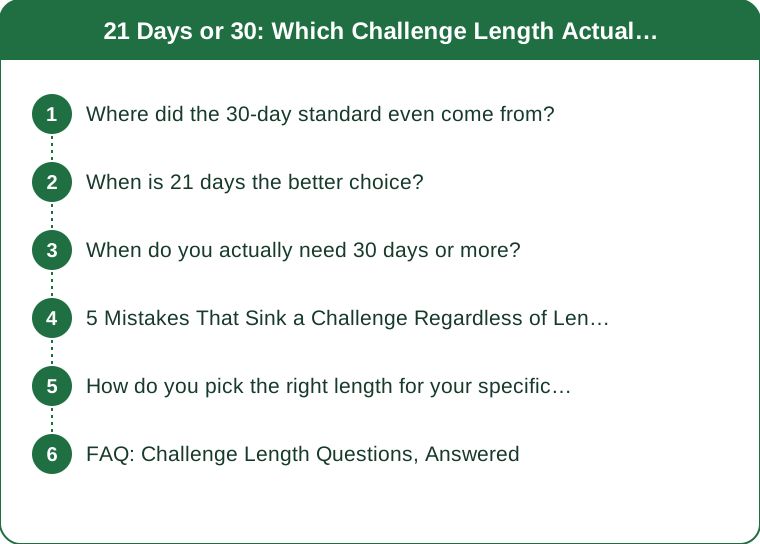
Where did the 30-day standard even come from?
Convenience, mostly. Thirty days is one calendar page, which made it an easy unit for magazines and later for apps. It was never a physiological finding.
The adjacent myth — that a habit takes 21 days — comes from a 1960 observation by a plastic surgeon about how long patients took to adjust to a changed appearance. It was never a study of habit formation. Actual habit-formation research puts the range far wider, generally somewhere between two and eight months depending on the behavior’s complexity, with simple daily behaviors landing at the short end.
So neither number is grounded in what it is used to justify. Which is oddly freeing: since both are arbitrary, you can pick based on what your specific goal actually requires.
That is a better question than how long should a challenge be. The useful version is: how many sessions does this adaptation need, and how hard is it to keep showing up?
When is 21 days the better choice?
Pick 21 when the barrier is starting, not adapting.
Good fits:
- Daily mobility or stretching. The change you want is consistency, and the sessions are short and low-fatigue.
- A new habit at a new time of day. Morning walks, a lunchtime movement break, an evening wind-down.
- Skill practice. Handstand holds, a specific yoga pose, jump rope coordination. Progress here comes from frequency of exposure, not accumulated volume.
- Anything you have quit before around week two.
The advantage is psychological and real: 21 days is visible from the start. Three weeks is a length people can hold in their head, which meaningfully changes the day-12 experience — you are two-thirds through rather than a third.
And if it goes well, extend it. A completed 21-day block followed by a second one produces better adherence than a single 42-day block, because the finish line arrives while motivation is still intact.
When do you actually need 30 days or more?
Pick 30 when you need accumulated training volume for a physical adaptation to show up.
Good fits:
- Strength progressions. Push-ups, squats, planks. Neural adaptations start within two weeks, but a visible jump in reps generally needs four-plus weeks of progressive loading.
- Endurance building. Running, cycling, and walking distance goals need enough weeks for cardiovascular adaptation to register.
- Body composition goals. These are the ones people most often set at 30 days and should probably set at 90. A month is enough to build the habit, rarely enough to see the outcome.
A useful check before committing: count the sessions, not the days. A 30-day challenge at 3 sessions per week is only 13 sessions — not a lot of stimulus. A 21-day daily challenge is 21. The calendar length is a poor proxy for the training that actually happens inside it.
If the goal needs 20-plus quality sessions and you can realistically train four times a week, you need five weeks, not four. Set the length from the arithmetic.

5 Mistakes That Sink a Challenge Regardless of Length
1. Starting at the intensity you want to finish at. Day 1 at your maximum leaves nowhere to progress and guarantees soreness at exactly the moment the habit is most fragile. Start at roughly 60 percent of what you could do.
2. Choosing a daily challenge for a goal that needs recovery. Daily heavy squats is not a challenge, it is an injury schedule. Daily is for low-fatigue work — mobility, walking, skill practice. Strength work needs rest days built in.
3. No plan for the missed day. Everyone misses one. Without a rule, a single miss becomes a quit. Decide in advance: miss one, continue; miss two consecutively, restart that week only. The rule matters more than which rule you pick.
4. Tracking nothing measurable. “Feeling stronger” evaporates under a hard week. Log the actual number — reps, minutes, distance — so that on day 18 you have evidence rather than a vibe.
5. No plan for day 31. The most common failure is not quitting mid-challenge; it is finishing and reverting completely. Decide what happens after before you start, because the day after a finish line is when the structure disappears.
How do you pick the right length for your specific goal?
Work through it in three steps.
Step 1 — Name the adaptation. Is the win doing the thing consistently, or the thing measurably changing? Consistency goals lean 21. Measurable-change goals lean 30 or more.
Step 2 — Count the sessions the adaptation needs. Skill and mobility: roughly 15 to 20 exposures. Strength: 12 to 16 progressive sessions. Endurance: 16 to 20. Then divide by your realistic weekly frequency to get the calendar length, and use that number rather than the round one.
Step 3 — Subtract your honest recovery needs. If the plan requires daily work and your body needs two rest days a week, the plan is wrong, not your body. Extend the calendar rather than compressing the recovery.
A worked example: you want to double your push-ups. That is strength, needs about 14 progressive sessions, and push-ups want a rest day between hard sessions — so 4 sessions a week, 14 sessions, roughly 25 days. Not 30, not 21. The arithmetic gave you a better answer than either default.
If you are returning from injury, pregnancy, or a long layoff, build in more time rather than more intensity, and check with your provider before starting something daily. This is general information, not medical advice.
FAQ: Challenge Length Questions, Answered
Is a 7-day challenge worth doing?
As a restart mechanism, yes — it is genuinely useful for breaking a stalled stretch and rebuilding momentum. As a route to physical change, no. Treat a week as an on-ramp to something longer rather than a standalone goal.
Can I run two challenges at once?
One at most, plus one very low-effort habit. Two demanding challenges compete for the same daily willpower and both usually fail. If you want two, stagger them — finish one, then start the next.
What if I want to keep going past the end date?
Good sign, and the ideal outcome. Take two easier days, then start a new block with a slightly different goal. The reset preserves the finish-line effect that made the first block work, which continuous open-ended training does not give you.
TL;DR: Match the length to the adaptation and the abandonment problem mostly disappears.
- Neither 21 nor 30 has a scientific basis — 30 is a calendar page and the 21-day habit claim was never a habit study.
- 21 days for habit, mobility, and skill goals — the finish line stays visible, which changes the day-12 experience.
- 30-plus days for strength, endurance, and anything needing accumulated volume.
- Count sessions, not days. Three sessions a week for a month is only 13 sessions.
- Start at 60 percent, set a missed-day rule in advance, and track a real number.
- Decide what day 31 looks like before day 1.
Do the arithmetic in step 2 and you will usually land on an odd number like 25 days — which is a much better plan than the round one.
Keep Reading
This article is for general informational and styling purposes only. Fit, sizing, and product availability may vary.